
Friday Fun Fact – 10th July 2026

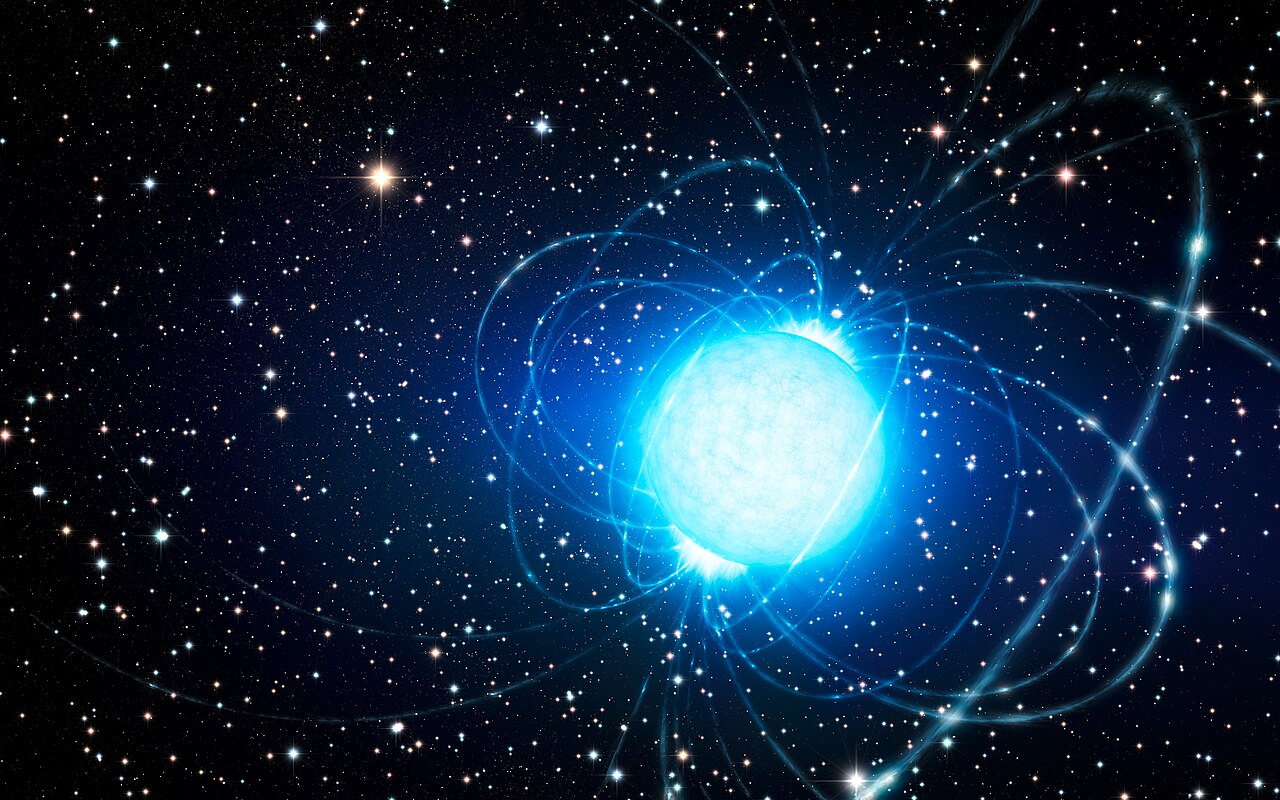
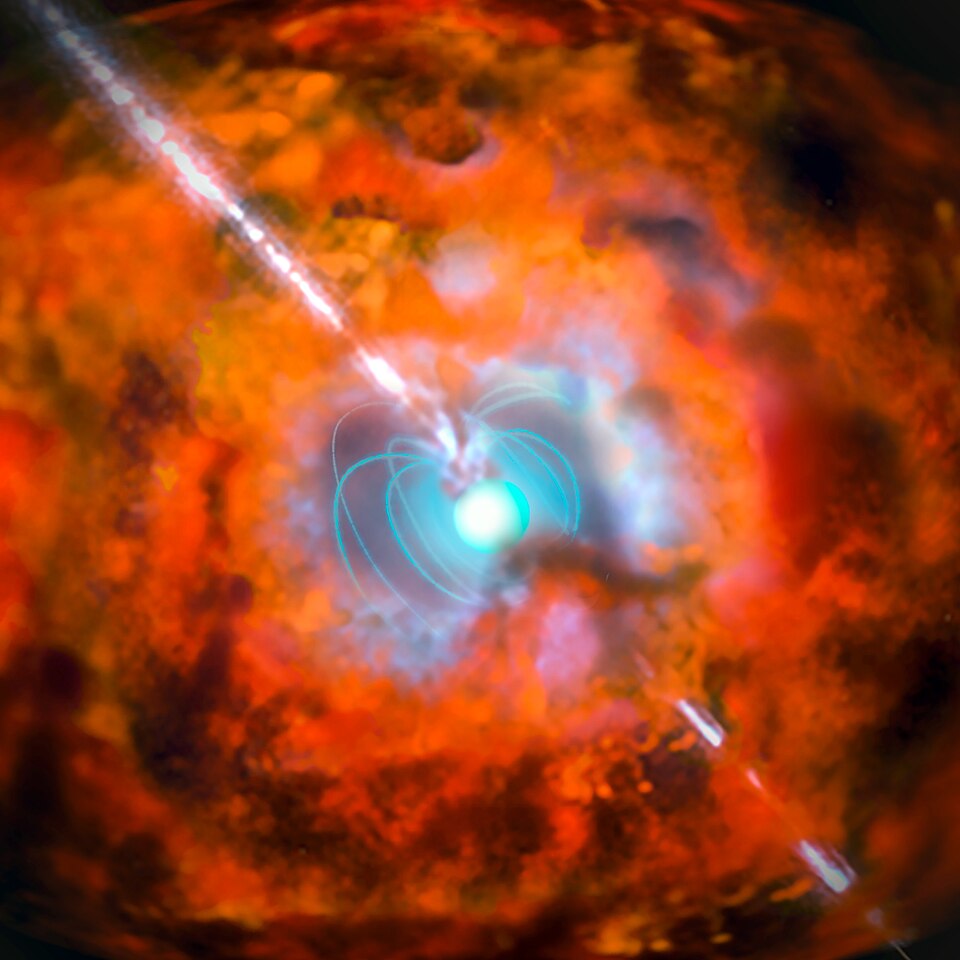
This artist’s impression shows the magnetar CXOU J164710.2-455216 in the very rich and young star cluster Westerlund 1. This remarkable cluster contains hundreds of very massive stars, some shining with a brilliance of almost one million suns. European astronomers have for the first time demonstrated that this magnetar — an unusual type of neutron star with an extremely strong magnetic field — probably was formed as part of a binary star system. The discovery of the magnetar’s former companion elsewhere in the cluster helps solve the mystery of how a star that started off so massive could become a magnetar, rather than collapse into a black hole.

Magnetars

Magnetars are able to release enormous amounts of energy, during sudden & intense bursts. A single flare from a Magnetar can release more energy in a fraction of a second than the Sun emits over an entire year. This is roughly equivalent to 10^44 Joules. (100,000,000,000,000,000,000,000,000,000,000,000,000,000,000 J), which is comparable to a supernova explosion, but happens within a millisecond to a few seconds.

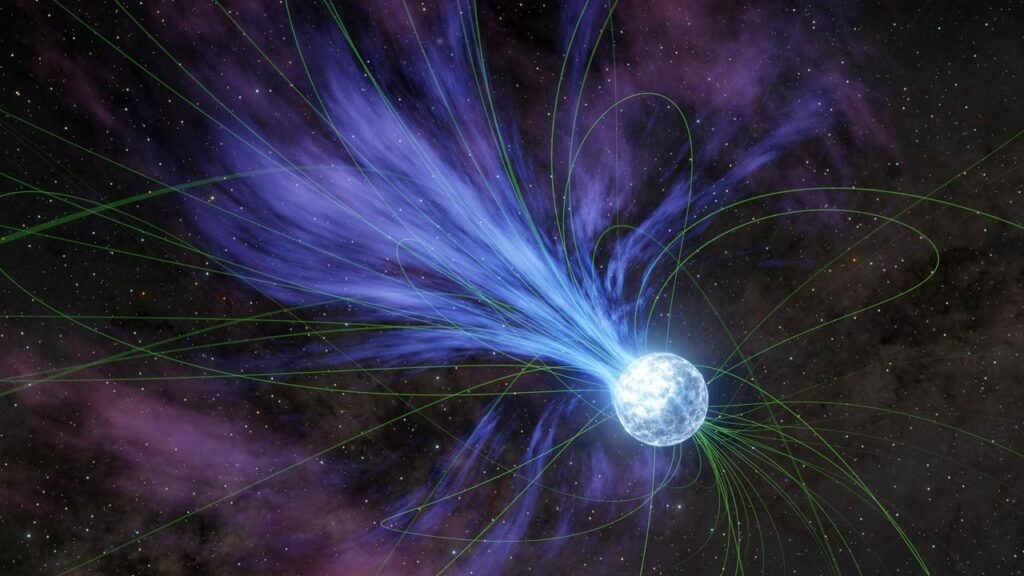
This happens because of their intense magnetic fields – when the field lines snap, and reconnect on the magnetar’s surface, it triggers a violent energy release, along with Starquakes.
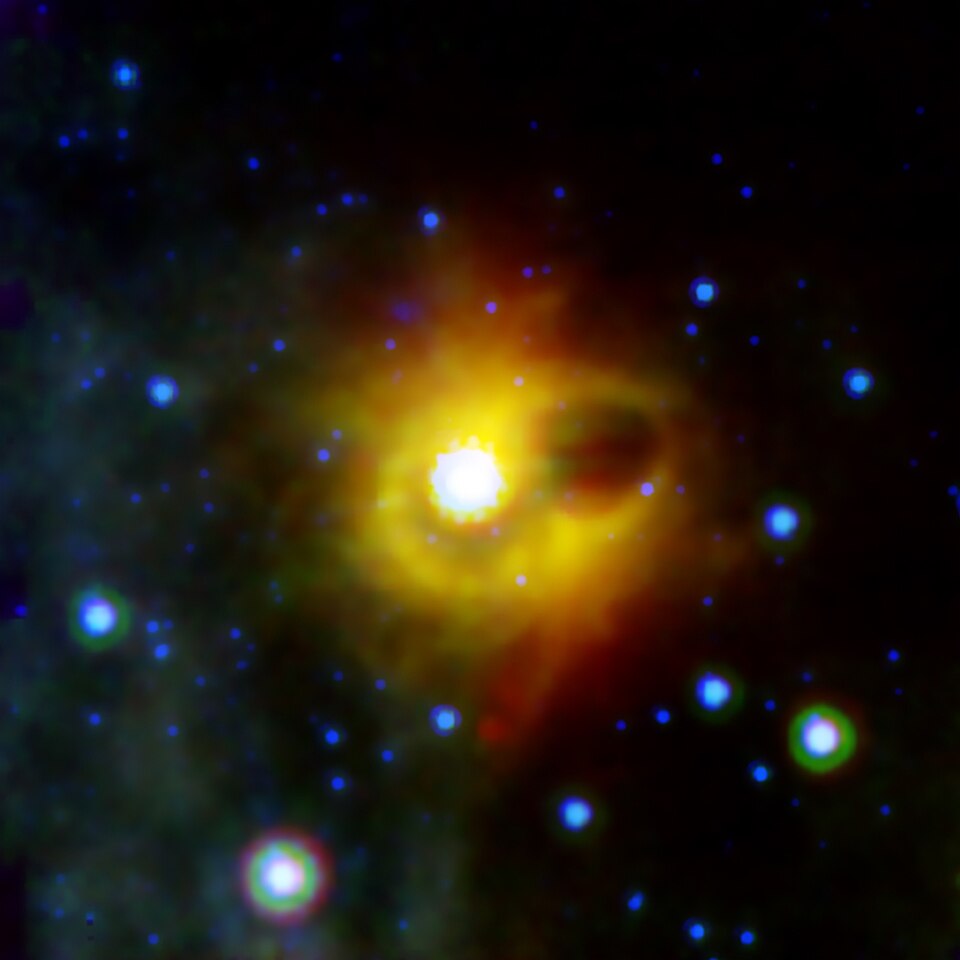
Magnetar SGR 1900+14 (centre of image) showing a surrounding ring of gas 7 light-years across in infrared light, as seen by the Spitzer Space Telescope. The magnetar itself is not visible at this wavelength but has been seen in X-ray light.

But what are they?

Magnetars are a type of neutron star, with an extremely powerful magnetic field, (of at least 109 Gauss). The stars magnetic field decay, power the emission of high-energy electromagnetic radiation, particularly X-rays and Gamma rays.
They are around 20 kilometres in diameter, and have a mass of about 1.4 M☉. They originate from a star that has collapsed with a mass of 10-25 M☉. The material inside of one is such that a tablespoon of matter, would weigh over 100 million tons.
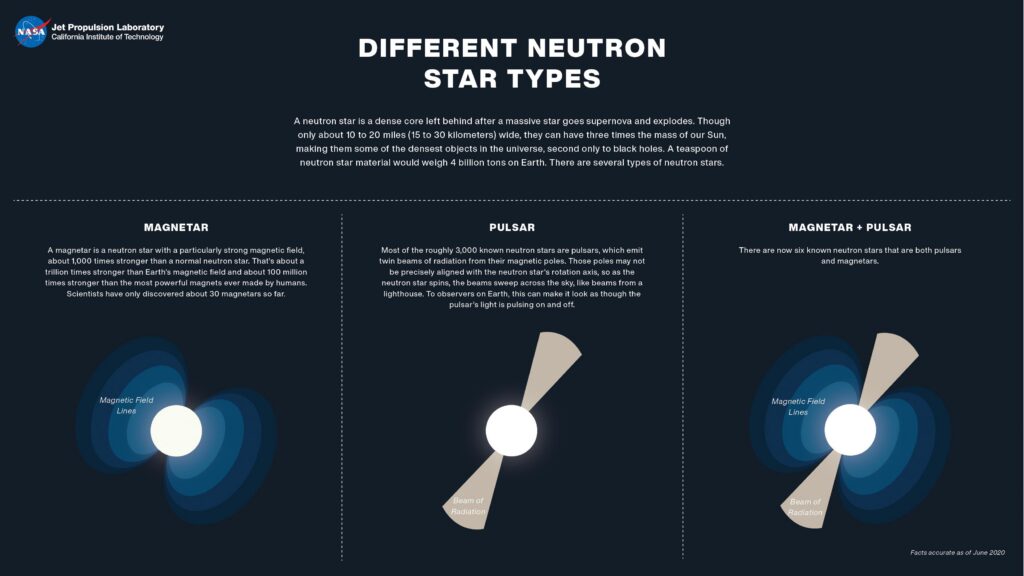
Different Types of Neutron Stars. Neutron stars, or cores leftover from exploded stars, are some of the densest objects in the known Universe. There are several types, including magnetars and pulsars.

How are they different?

Magnetars are distinguished from other neutron stars, by their increasingly stronger magnetic fields, and also have a much slower rotational period, than the insanely fast pulsars.
Most magnetars that have been observed typically rotate once every two to ten seconds, whereas a typical neutron stars, they would rotate one to ten times per second.
Compared to other neutron stars, the active life of a Magnetar is much shorter, where their magnetic fields decay within a period of about 10,000 years. After which, their activity and strong X-ray emissions cease.
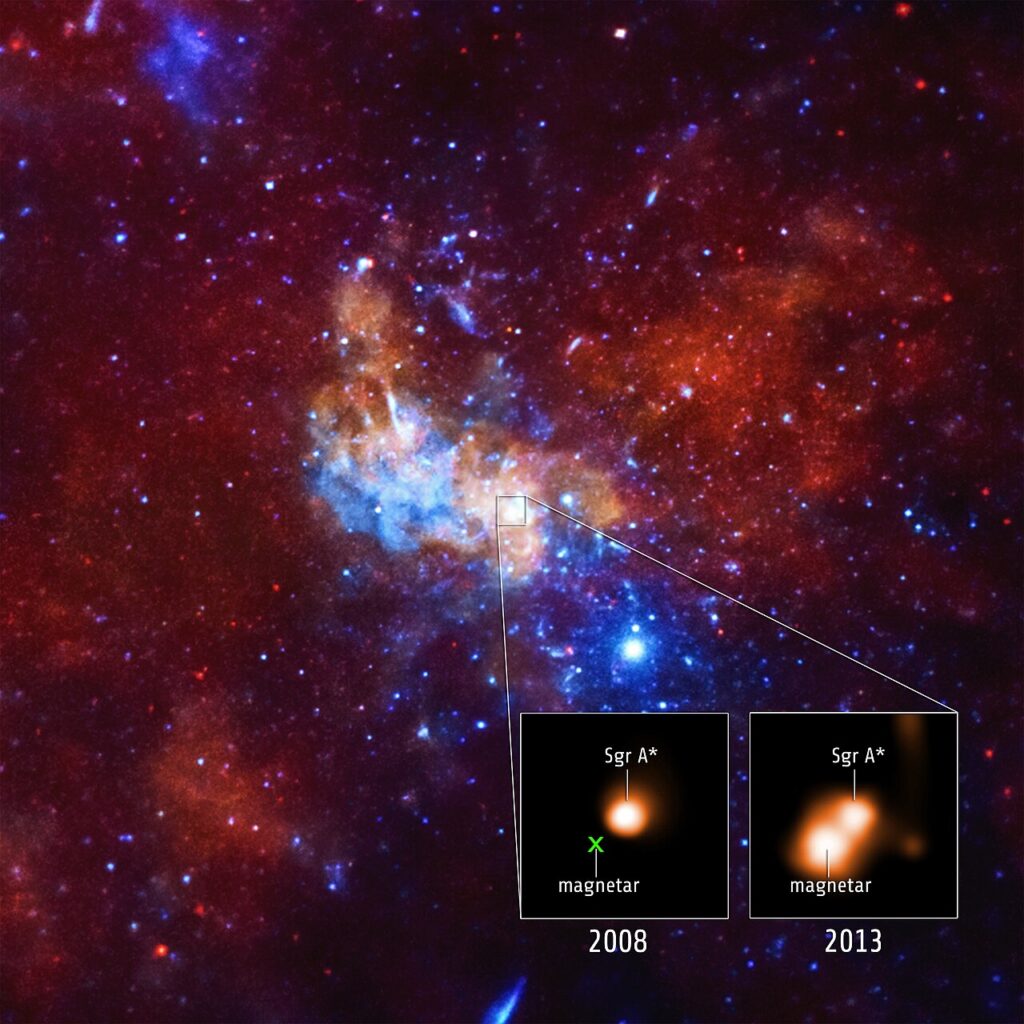
Given the number of observable magnetars, there may be 30 million inactive magnetars in the Milky way

Comments

No comments yet. Why don’t you start the discussion?

Leave a Reply

Your email address will not be published. Required fields are marked *