

Psyche Mars Flyby
29th May 2026
On the 15th May, 2026, the spacecraft Psyche had a flyby of Mars, to use it as a gravity assist to launch it towards the asteroid belt. It’s enroute to study the largest known metallic asteroid in our Solar System, and of the same name, Psyche. The gravity assist has put them on course for arrival at the asteroid in the summer of 2029.
While the gravity assist was the main point of the Mars Flyby, NASA also used it as an opportunity to test out some of the equipment that Psyche has onboard, and captured 1000s of photos at the same time.
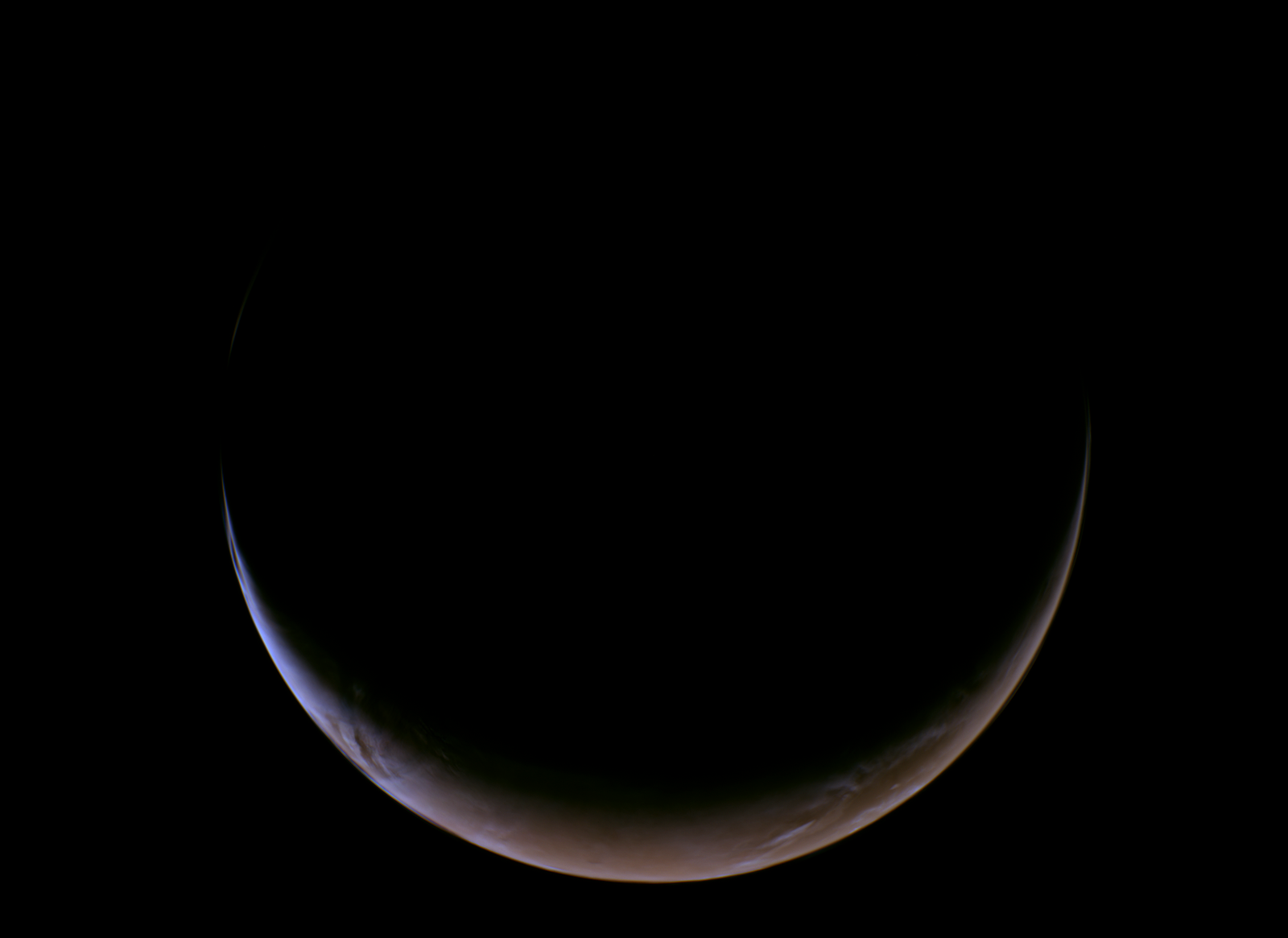
Because Psyche approached Mars from a high phase angle, the planet appeared as a thin crescent in the days running up to its closest approach, lit by the sunlight reflecting off its surface.
Seen Right: A photo of a Crescent Mars, as Psyche was approaching Mars for the gravity assist, taken on May 15th, 2026.
Credit: NASA / JPL-Caltech / ASU
Psyche shown using NASA’s “Eyes On The Solar System” tool. Credit: NASA
More About Psyche
The Spacecraft, Psyche is a 30KG satellite on its way to Asteroid Psyche, to explore information about the origin of Planetary Cores, by orbiting and studying the asteroid, beginning in 2019.
It was originally launched in October 2023, and has spent 3 years travelling towards Mars, to use it for a gravity assist to eventually reach 16 Psyche in August 2029. It is expected to spend 817 days in orbit around the asteroid, using 3 main instruments to provide detailed information about 16 Psyche, and hopefully giving eyes to use on how our own planet may have potentially been formed.
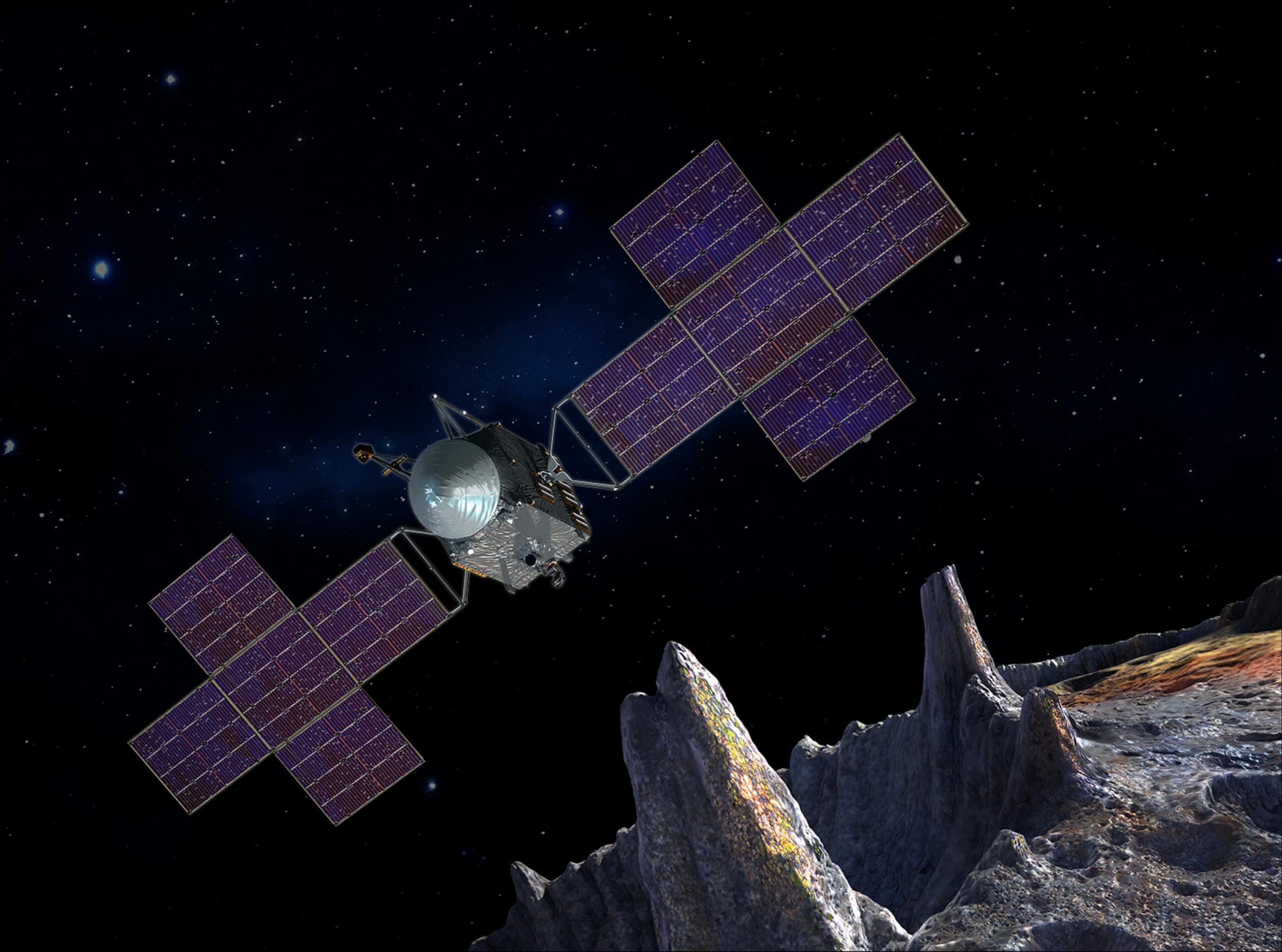
Seen Right: An artist’s illustration of what Psyche would look like whilst in orbit around 16 Psyche.
Credit: NASA / JPL-Caltech / Arizona State University.
| Instrument | Function | Team |
|---|---|---|
| The Psyche Multispectral Imager | It will provide high-resolution images using filters to discriminate between 16 Psyche’s metallic and silicate components. The instrument consists of a pair of identical cameras designed to acquire geologic, compositional, and topographic data. The purpose of the second camera is to provide redundancy for mission-critical optical navigation. | Arizona State University |
| Psyche Gamma-ray and Neutron Spectrometer | It will detect, measure, and map 16 Psyche’s elemental composition. The instrument is mountain on a 6-foot (1.8m) boom arm to distance the sensors from background radiation created by energetic particles interacting with the spacecraft and to provide an unobstructed field of view. | Applied Physics Laboratory at John Hopkin University |
| Psyche Magnetometer | The Psyche Magnetometer is designed to detect and measure the remanent magnetic field of the asteroid. It is composed of two identical high-sensitivity magnetic field sensors located at the middle and outer end of a 6-foot (1.8m) boom. | Massachusetts Institute of Technology and Technical University of Denmark |
| Deep Space Optical Communications (DSOC) | The Psyche mission will test a sophisticated new laser communication technology that encodes data in infrared-photons (rather than radio waves) to communicate with a probe in deep space from Earth. Using a shorter wavelength allows the spacecraft to transmit more data in a given amount of time. | Jet Propulsion Laboratory |
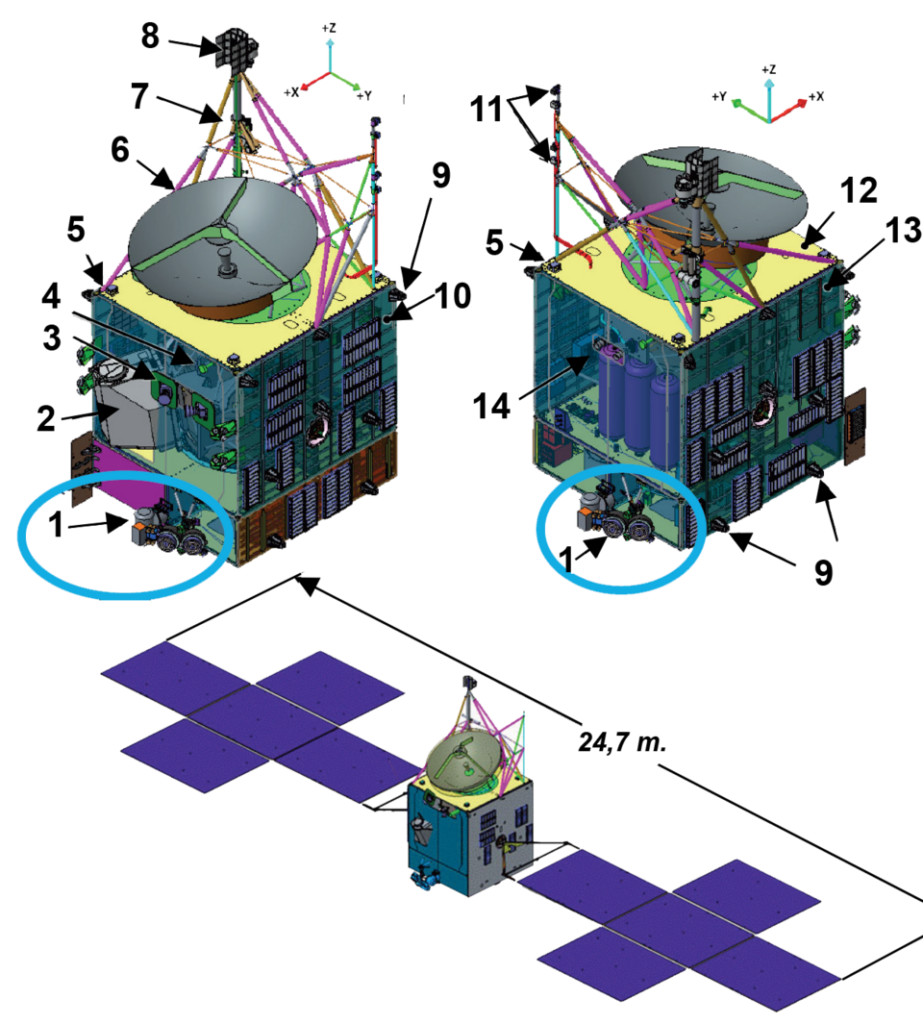
Instruments onboard of the spacecraft:
1. Hall-Effect Thrusters
2. Optical telecommunications system.
3. Star Trackers
4. Low-gain antenna
5. Sun Sensor
6. X-Band High-Gain Antenna
7. Neutron Spectrometer
8. Gamma-ray spectrometer.
9. Cold gas thrusters
10. -Y Panel
11. Magnetometer
12. Top Deck
13. +Y Panel
14. Multispectral Imagers (x2)
Leave a Reply