Author: jayden

  • FridayFunFact – 5th June 2026

    FridayFunFact – 5th June 2026

    The end of the MAVEN Mission

    5th June 2026

    MAVEN (otherwise known as the Mars Atmosphere and Volatile Evolution Mission), was the first mission devoted to understanding the upper Martian atmosphere. The mission has recently been declared as ended, after NASA lost contact with the probe on December 6th, 2025, and was declared as finalized on June 3rd, 2026, after extensive efforts to rescue the stricken probe.

    MAVEN was originally launched on an Atlas V rocket from Cape Canaveral Air Force Station, Florida, on the 18th November 2013, and would enter into orbit around Mars on the 22nd September 2014. It would spend its time analysing the planet’s upper atmosphere and ionosphere, to examine how and what rate the solar wind was stripping away volatile compounds from it’s surface.

    It’s primary objectives where as follows:

    • Measuring the composition and structure of the upper atmosphere and ionosphere today, and determine the processes that were responsible for controlling them.
    • Measuring the rate of gas losses from the top of the Martian atmosphere to space, and determine those processes that were responsible for controlling them.
    • Determine properties and characteristics that would allow NASA to extrapolate backwards in time to determine the integrated loss to space over the four-billion-year history recorded in the geological record.

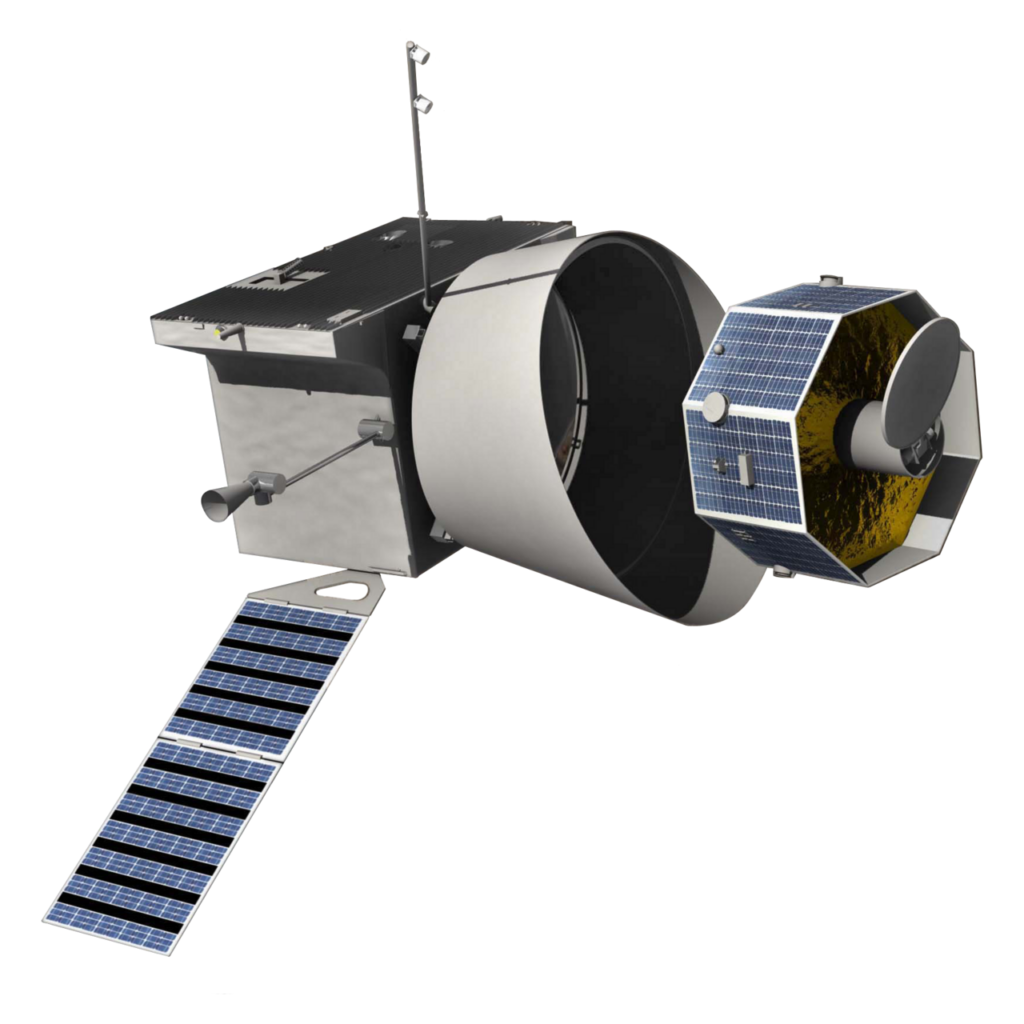
    Pictured Above: A MAVEN artist’s concept depicting the MAVEN spacecraft near Mars.

    Credit: NASA / GSFC Created: 23rd June, 2013

    Loss of Communication with MAVEN

    NASA originally lost contact with MAVEN on the 6th December 2025. The last telemetry would be received on the 4th December, but a very brief fragment of tracking data from the 6th December would also be transmitted.
    This would show that the spacecraft was rotating in an unexpected matter when it emerged from behind Mars, and that its orbit may have been changed.
    NASA continued it’s attempts to recover the signal using antennas of the Deep Space Network up until March 2026.

    The loss of MAVEN impacted it’s role as a communications relay for surface rovers, Curiosity and Perseverance, with teams at both NASA & the ESA working on their remaining active orbiters (Mars Odyssey, MRO, and TGO), to ensure that communications would continue.
    On the 16th and 20th December, Curiosity was asked to use it’s MastCam to image where MAVEN was expected to be in it’s orbit, but is not visible either time.

    On the 3rd of June, 2026, NASA would announce that the mission had ended after the review determined the spacecraft was not recoverable, and no longer capable of performing its science and data relay mission. According to their findings, MAVEN entered into safe mode, and was rotating at a unusually high rate, causing the spacecraft’s batteries to drain and putting it in an unrecoverable state. A root cause is still to be suggested or determined. Mike Moreau, the project manager, stated that MAVEN could remain derelict in Mars orbit for the next 50 to 100 years before entering and burning up in the Martian atmosphere.


    Deep Space Network’s current status:

  • FridayFunFact – 22nd May 2025

    FridayFunFact – 22nd May 2025

    MIR

    MIR was the International Space Station, before the International Space Station. It was built by the Soviet Union originally in 1986, and was intentionally de-orbited on 23rd March, 2001.

    Fun Facts about MIR

    MIR was the first continuously inhabited space station in orbit, and held the first record for the longest continuous human presence in space, at 3,644 days, until it was surpassed by the International Space Station back in 2010.

    Valeri Polyakov, spent 437 days on the station between 1994 & 1995, making him the record holder for the longest single human spaceflight.

    It was designed to store 3 residents’ long term, or larger crews in a shorter term, which peaked at ten during STS-71.

    It was a important new stage for the Soviet space program’s station development, following the success of six crewed single-module stations under the Salyut programme.

  • Friday Fun Fact – 29th May 2026

    Friday Fun Fact – 29th May 2026

    Psyche Mars Flyby

    29th May 2026

    On the 15th May, 2026, the spacecraft Psyche had a flyby of Mars, to use it as a gravity assist to launch it towards the asteroid belt. It’s enroute to study the largest known metallic asteroid in our Solar System, and of the same name, Psyche. The gravity assist has put them on course for arrival at the asteroid in the summer of 2029.

    While the gravity assist was the main point of the Mars Flyby, NASA also used it as an opportunity to test out some of the equipment that Psyche has onboard, and captured 1000s of photos at the same time.

    Because Psyche approached Mars from a high phase angle, the planet appeared as a thin crescent in the days running up to its closest approach, lit by the sunlight reflecting off its surface.

    Seen Right: A photo of a Crescent Mars, as Psyche was approaching Mars for the gravity assist, taken on May 15th, 2026.
    Credit: NASA / JPL-Caltech / ASU

    Psyche shown using NASA’s “Eyes On The Solar System” tool. Credit: NASA


    More About Psyche

    The Spacecraft, Psyche is a 30KG satellite on its way to Asteroid Psyche, to explore information about the origin of Planetary Cores, by orbiting and studying the asteroid, beginning in 2019.

    It was originally launched in October 2023, and has spent 3 years travelling towards Mars, to use it for a gravity assist to eventually reach 16 Psyche in August 2029. It is expected to spend 817 days in orbit around the asteroid, using 3 main instruments to provide detailed information about 16 Psyche, and hopefully giving eyes to use on how our own planet may have potentially been formed.

    Seen Right: An artist’s illustration of what Psyche would look like whilst in orbit around 16 Psyche.
    Credit: NASA / JPL-Caltech / Arizona State University.

    InstrumentFunctionTeam
    The Psyche Multispectral ImagerIt will provide high-resolution images using filters to discriminate between 16 Psyche’s metallic and silicate components.
    The instrument consists of a pair of identical cameras designed to acquire geologic, compositional, and topographic data.
    The purpose of the second camera is to provide redundancy for mission-critical optical navigation.
    Arizona State University
    Psyche Gamma-ray and Neutron SpectrometerIt will detect, measure, and map 16 Psyche’s elemental composition.
    The instrument is mountain on a 6-foot (1.8m) boom arm to distance the sensors from background radiation created by energetic particles interacting with the spacecraft and to provide an unobstructed field of view.
    Applied Physics Laboratory at John Hopkin University
    Psyche MagnetometerThe Psyche Magnetometer is designed to detect and measure the remanent magnetic field of the asteroid.
    It is composed of two identical high-sensitivity magnetic field sensors located at the middle and outer end of a 6-foot (1.8m) boom.
    Massachusetts Institute of Technology and Technical University of Denmark
    Deep Space Optical Communications (DSOC)The Psyche mission will test a sophisticated new laser communication technology that encodes data in infrared-photons (rather than radio waves) to communicate with a probe in deep space from Earth.
    Using a shorter wavelength allows the spacecraft to transmit more data in a given amount of time.
    Jet Propulsion Laboratory

    Instruments onboard of the spacecraft:
    1. Hall-Effect Thrusters
    2. Optical telecommunications system.
    3. Star Trackers
    4. Low-gain antenna
    5. Sun Sensor
    6. X-Band High-Gain Antenna
    7. Neutron Spectrometer
    8. Gamma-ray spectrometer.
    9. Cold gas thrusters
    10. -Y Panel
    11. Magnetometer
    12. Top Deck
    13. +Y Panel
    14. Multispectral Imagers (x2)

  • Friday Fun Fact – 15th May 2026

    Friday Fun Fact – 15th May 2026

    Voyager 1’s next Milestone

    15th May, 2026.

    Upcoming this year, on the 15th November 2026 (roughly), Voyager 1 will reach a far enough distance, that it will take light 1 day to reach it from Earth. This means any communications with the 50 year old probe will take 2 days to get an answer.

    Voyager 1 is currently 15.78 billion miles away, and 1 light day is roughly 16 billion miles away. It will hit that milestone, as mentioned, in mid-November. But what is Voyager 1?

    Voyager 1 is a robotic probe, originally built to visit Jupiter & Saturn back in 1977. This was during a rare planetary alignment, which only occurs every 176 years, where Jupiter, Saturn, Uranus and Neptune are aligned in such a way that a spacecraft could use each planet’s gravitational pull as a slingshot – which significantly reduces travel time and fuel to be able to reach the outer solar system.

    A list of Voyager 1’s Acheivments:

    • The first spacecraft to reach interstellar space, back on August 25th, 2012, when it crossed the Heliopause, allowing it to send back the first direct measurements of the galactic magnetic field and cosmic rays.
    • It is the furthest man-made object from Earth
    • It captured the first high-resolution images of Jupiter and its moons. Major discoveries included finding active volcanic activity on the moon Io, seeing the first lightning beyond Earth, and detecting Jupiter’s ring system.
    • First highly detailed look at Saturn, and Titan, showing highly detailed views of the planet’s complex ring structures.
    • It captured the Pale Blue Dot image, a mosaic which showed the earth as a tiny, speck of light suspended in the vastness of space.
    • First spacecraft to detect a nitrogen-rich atmosphere found beyond our home planet (Titan’s atmosphere around Saturn).

    A photo of Voyager 1’s launch, on top of a Tian IIIE-Centaur rocket. This happened on September 5th, 1977. Credit: NASA

    A diagram of the Voyager probes, pointing out each item.
    InstrumentVoyager 1Voyager 2
    Cosmic Ray Subsystem (CRS)Off to save power (Feb 25th, 2025)On
    Low-Energy Charged Particles (LECP)Off to save power (April 17th, 2026)Off to save power (March 24th, 2025)
    Magnetometer (MAG)OnOn
    Plasma Wave Subsystem (PWS)OnOn
    Plasma Science (PLS)Off because of degraded performance (Feb 1st, 2007)Off to save power (Sept 26th, 2024)
    Imaging Science Subsystem (ISS)Wide-angle and narrow-angle cameras off to save power (Feb 14th, 1990)Wide-angle and narrow-angle cameras off to save power (Oct 10th and Dec 5th, 1989)
    Infared Interferometer Spectrometer and Radiometer (IRIS)Off to save power (June 3rd, 1998)Off to save power (Feb 1st, 2007)
    Photopolarimeter Subsystem (PPS)Off because of degraded performance (Jan 29th, 1980)Off because of degraded performance (April 3rd, 1991)
    Planetary Radio Astronomy (PRA)Off to save power (Jan 15th, 2008)Off to save power (Feb 21st, 2008)
    Ultraviolet Spectrometer (UVS)Off to save power (April 19th, 2016)Off to save power (Nov 12th, 1998)

  • Friday Fun Fact – 8th May 2026

    Friday Fun Fact – 8th May 2026

    The Oldest Functioning Sattelite

    8th May 2026

    The oldest satellite that is still readily transmitting today is AMSAT-OSCAR 7, otherwise known as AO-7. It is a amateur radio satellite, constructed in the 1970’s by AMSAT. It was launched into Low Earth Orbit back on November 15, 1974, and remained operational until a battery failure in 1981.

    After 21 years of silence, the sattelite’s signal was picked up again on June 21, 2002. It was then learnt that during that time, it was actually used briefly for the anti-communist opposition in Poland, during the time of Martial Law, in 1982.

    AMSAT reported in 2015, that the satellite was only receiving power from it’s solar panels, as a short circuit in the battery had caused the initial outage. When this later became an open circuit, due to time, it now functions only on direct solar light.

    AO-7 has a mass of 28.6KG, and was placed into a 1,444km (Pe), x 1459km (Ap) Orbit. It is shaped as an octagonal prism, 36cm tall, and 42.4cm in diameter. It has a single circularly polarized, canted turnstile VHF / UHF antenna system. Four radio masts are mounted 90 degree intervals on the base of the satellite and two experimental repeater systems provided store-and-forward for morse code and teletype messages.

    An artist’s interpretation of the AO-7 Satellite.

    Credit: AMSAT-DL

    A live tracker of the AO7 Sattelite, powered by N2YO.com, which is a website allowing you to track any satellite on the NORAD database.

  • Friday Fun Fact – May 1st 2026

    Friday Fun Fact – May 1st 2026

    Gravitational Lensing

    May 1st, 2026

    Gravitational lensing is a phenomenon, where something that has a large gravitational pull, such as a galaxy cluster, a supermassive black hole, or quasars, warps space and time around them, causing visible distortion that bends light in unique ways around the object.

    It was first observed in 1919, by 3 British Astronomers, Arthur Stanley Eddington, Frank Watson Dyson, and Andrew Crommelin, where they did an experiment to see if the Sun’s Gravity would bend starlight in such a way during a total solar eclipse, if they could see & photograph stars that would normally be impossible to do so. They used 3 telescopes, 2 in the Brazilian city of Sobral, and one on the West African Island of Principe, to complete the experiment. This allowed them to see the same star on both sides of the sun, due to the gravitational lensing.

    In current practice, we have made numerous observations of gravitational lensing using the Hubble Space Telescope, and more recently, the James Webb Space Telescope.
    Popular examples of these include photos of Hubble’s image of the galaxy cluster, J1038+4849, which has extreme gravitational lensing surrounding it, and James Webb’s, First Deep Field, which showed extensive lensing around a center galaxy cluster.

    An original high-resolution image of the 1919 solar eclipse, before the digital restoration would reveal a few pinpoint stars visible just above the large prominence arching across the Sun’s upper right limb. Another is visible below the Sun’s limb and beyond it’s wispy corona near the bottom of the image
    F.W Dyson, A. S. Eddington, and C.Davidson.
    Credit: NASA

    Interactive 3D Model of the Hubble Space Telescope.
    Credit: @europeansouthernobservatory on Sketchfab.com

    Interactive 3D Model of the James Webb Space Telescope.
    Credit: Paul (Sketchfab) on Sketchfab, who uploaded it as a 3D Model Courtesy of NASA.

    James’ Webb’s First Deep Field, showing the extensive gravitational lensing in the middle.
    Credit: NASA, JWST

    Image from the Hubble Space Telescope showing the gravitational lensing due to the galaxy cluster, SDSS J1038+4849. It appears to show a smiling face, but the two eyes are two ellipitcal galaxies, while the arcs are distant galaxies that have been lensed by Gravity.
    Credit: NASA, ESA, Michael Gladders, HST

  • Friday Fun Fact – 24th April 2026

    Friday Fun Fact – 24th April 2026

    Neutrinos in the Sun

    24th April 2026

    Neutrinos in the Sun is an image of the sun physically shot through the earth. Neutrinos are a form of particle that pass through the earth and us constantly, but are very hard to detect. Readily produced in nuclear reactions and particle collisions, they can easily pass completely through planet Earth without once interacting with any other particle.

    In the 90s in Japan, they built a large-scale detector known as the Super-Kamiokande, to detect the very small amount of neutrinos that would interact with the water in the detector in such a way that the detectors on the wall would be able to pick them up.

    In a span of 500 days, data was collected that produced enough data to be able to “take” an image of the sun, using only neutrinos that are detected from nuclear fusion in the sun’s interior. The brighter parts are where more neutrinos are detected.

    An image of the inside of the Super Kamiokande, during a period of maintenance. Credit: The World Of Interiors, Leyla Spratley

  • Friday Fun Fact – 17th April 2026.

    Friday Fun Fact – 17th April 2026.

    PSR J1748-2446ad

    17th April, 2026.

    PSR J1748-2446ad is the fastest known spinning pulsar, which spins at an incredible rate of 716.35 times a second! This would mean it would spin 42,981 times in a minute. For a comparison, our sun rotates on average once every 27 days. This makes the pulsar rotate 1.67 billion times faster than our sun. At the equator, the pulsar is spinning at approximately 24% of the speed of light, or over 70,000km per second.

    The pulsar is located in a globular cluster of stars called Terzan 5, roughly 18,000 light years away. It’s part of a binary system, and does have frequent eclipses, which orbits each other in a 26-hour period. The other object is a presently un-named star, with a weight of 0.14 solar masses, and a radius of 5-6 that of the sun. Suggesting, that it may be a bloated main-sequence star, possibly still filling it’s Roche Lobe (a teardrop region surrounding a star in a binary system, in which orbiting material is gravitationally bound to that star.)

    The pulsar was originally discovered by Jason W.T. Hessels of McGill University, on November 10th, 2004, and confirmed on January 8th, 2005. With a radius of less than 16km across, it’s solar mass is somewhat smaller than 2 Mโ˜‰.

    > Pictured Right> The location of the pulsar in the night sky. It is located in the center of the yellow square, but too faint to be visible against the background.
    Credit: GALEX GR6/7 Data Release

    A video simulating roughly what the pulsar would sound like, based on NASA information.
    Credit: Sunstract.

    A diagram of a pulsar from a PDF about Pulsars by James Latimer, credited to the Handbook Of Pulsar Astronomy, by Lorimer and Kramer.

  • #FridayFunFact – 10th April 2026

    #FridayFunFact – 10th April 2026

    Artemis II Lunar Flyby

    10th April 2026

    On the 6th April, 2026, the Artemis II craft, Integrity, and the 4 astronauts, Reid, Victor, Christina, and Jeremy, completed their flyby around the Moon. The contact, as expected, was lost between 22:46 UTC, and 23:24 UTC, during their 40 minute stint around the far side of the moon, where the Deep Space Network has no direct connection with the vessel.

    During this time, they were able to view the far-side of the moon in unprecedented detail, including a solar eclipse after the blackout had finished, and where also able to see Impact Flashes from meteoroids impacting the dark portion of the moon.

    This has been the first return to the moon for 50 years, last done by Apollo 17, and the first Lunar Flyby in the same amount of time, as performed by Apollo 13, during their fateful mission. At an altitude of as little as 4,067 miles above the lunar surface, Artemis II created a new distance record, previously set by Apollo 13, which flew-by at just 158 miles above the surface. The new distance record stands at 252,755.8 miles, or 406,771 km.

    As part of the wake-up call on Day 6 before the historic flyby, a message recorded by Apollo 13 astronaut, the late Jim Lovell, was played as part of their wake-up call on the day, leading to emotional reactions. A recording can be found here.

    The Artemis II crew also proposed a rename of two unnamed crates spotted during the fly-by, one to be named Integrity, after the spacecraft, and one named Carroll, after Reid Wiseman‘s late wife.

    Credit: NASA, Artemis II Crew

    Image Credit: NASA, Artemis II Crew

  • #FridayFunFact – 3rd April 2026

    #FridayFunFact – 3rd April 2026

    Artemis II Launch

    3rd April 2026

    Today’s Fun Fact surrounds Artemis II, which launched successfully on Wednesday, 1st April. Currently, 4 Humans, 3 from NASA, and 1 from the CSA, are on their way to re-visit the moon for the first time in 50 years.

    Here’s some key things to note:

    • They are going to be bypassing the moon on a “Free-Return” trajectory, meaning if anything goes wrong, their orbit will bring them back to Earth.
    • They will be flying by the Moon, passing over it’s far side at a height of around 4,047 miles from the surface. This means at their furthest point, they will be the furthest humans have ever travelled, as Apollo 13 passed over the far side at a height of just 158 miles.
    • They are the first humans to be using the Deep Space Network, since the Apollo Missions, to communicate, as they are required too at the distances they are at
    • The entire mission will take a span of 10 days, and currently they are roughly 30 hours in. They will reach the furthest point, being on the far side of the moon, on Monday, April 6th.
    • If you want to find out more, see this NASA Link: https://www.nasa.gov/mission/artemis-ii/

    Credit: NASA

    Credit: NASA, Artemis II Crew.