

Chandra X-Ray Observatory
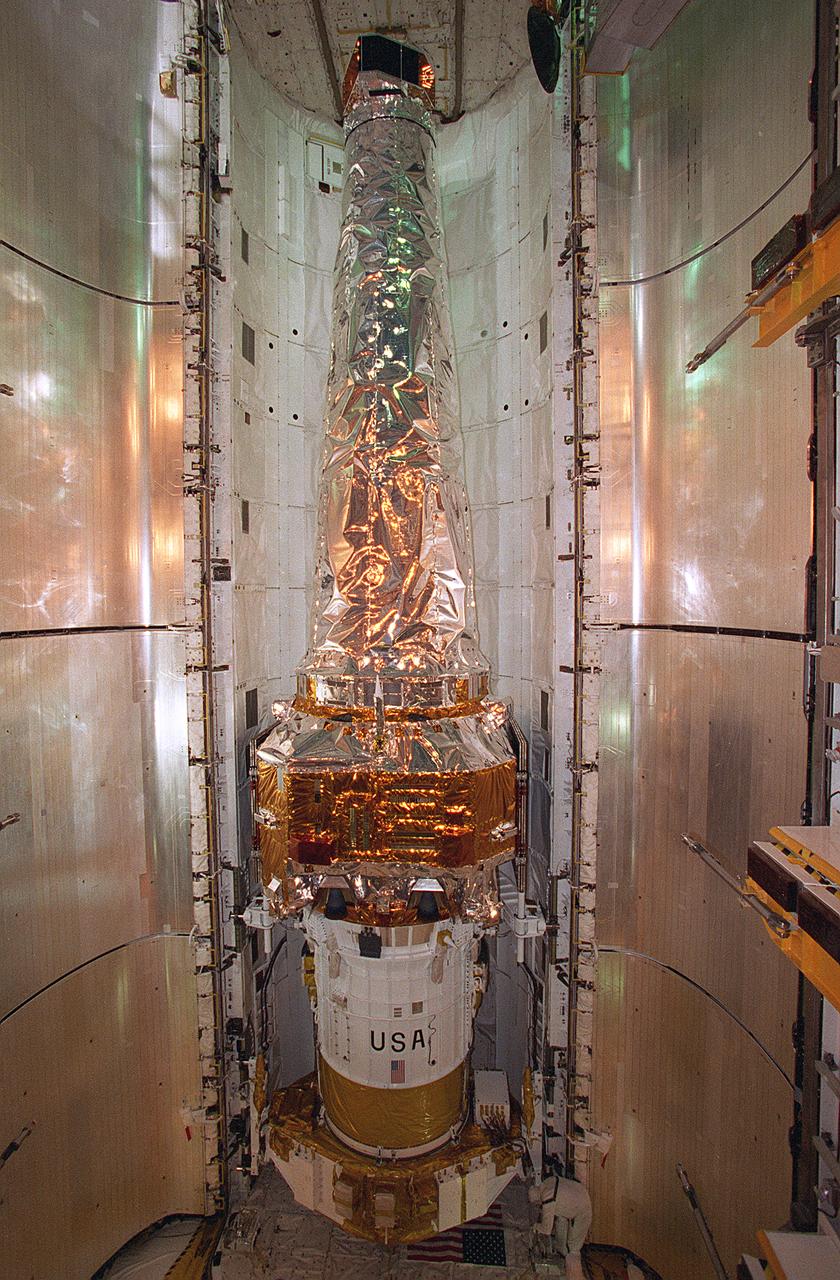
The Chandra X-Ray Observatory, is a flagship-class space telescope.
Living up to her name, the telescope is a X-Ray based observatory, which was originally launched aboard the Space Shuttle Columbia, during the STS-93 mission on July 23rd, 1999, 27 years and 1 day ago. She was originally intended to be launched in December 1998, but was delayed. Chandra is sensitive to X-Ray sources which are 100 times fainter than any other X-Ray telescope, thanks to it’s high angular resolution of it’s mirrors. It is in orbit around Earth, as opposed to James Webb which is at the Lagrange Point. It’s orbit takes roughly 64 hours. She is expected to be able to function for at least another decade, but growing issues with funding thanks to the US Congress in 2024, this is in doubt.
She was originally proposed in 1976, to NASA, by Riccardo Giacconi and Harvey Tananbaum, both astrophysicist’s, with Riccardo having a Nobel prize and is recognised for laying down the fundamentals of X-Ray astronomy. It was originally known as the AXAF (Advanced X-Ray Astrophysics Facility), and work would continue throughout the 1980’s & 1990’s. NASA originally launched the first X-Ray telescope, Einstein (HEAO-2), in 1978, which preceded the CXO (Chandra). She got the name Chandra as part of a contest, where Jatila van der Veen and Tyrel Johnson, suggested the name in honor of Indian-American astrophysicist, Subrahmanyan Chandreasekhar. (We mentioned his work last week!)
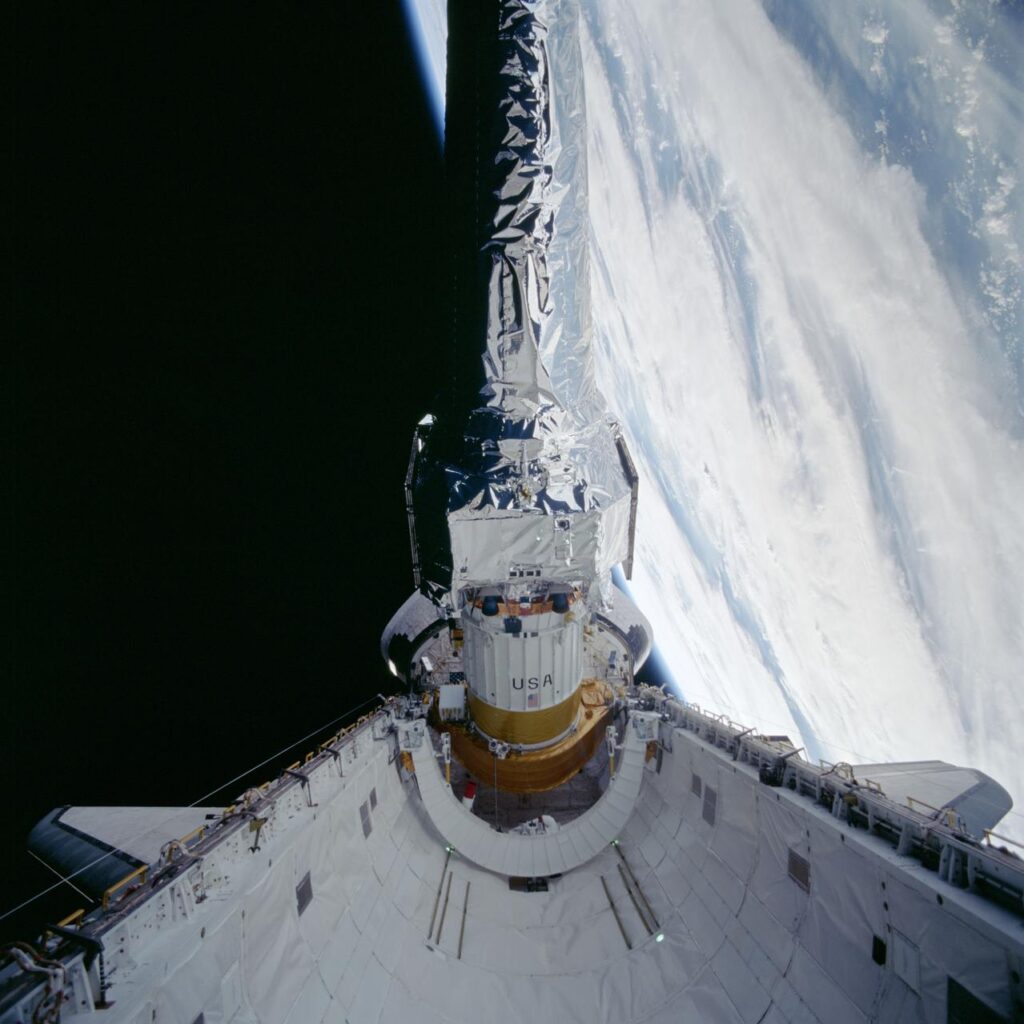
<- Pictured Right is a view of the Chandra Observatory during it’s deployment from the Space Shuttle ‘Columbia‘s payload bay. This was the primary duty of the mission of STS-93. You can also see it’s attached inertial motor below the top of the observatory, which was used to push it into a higher orbit for sufficient observation. It was likely taken by either Steve Hawley or Michel Tognini, but NASA doesn’t explicitly say.
Credit: NASA / Johnson Space Center / STS-93 Crew
Chandra has a number of amazing discoveries, a number of which are listed below:
- During the first-light image (the first one taken after becoming operational), in an observation of Cassiopeia A, a supernova remnant, it gave astronomers the first observation of a compact object at the centre of the remnant, likely a neutron star or black hole.
- In the Crab Nebula, it observed a never-before-seen ring around the central pulsar and jets that had only ever been partially seen by earlier telescopes
- It observed the X-Ray emissions for the first time around our galactic supermassive black hole, Sagittarius A*
- It confirmed that X-Rays in O-type stars (some of the biggest, and hottest stars), are generated through plasma shocks embedded in their wind.
- It found much more cool gas than expected spiralling into the center of the Andromeda Galaxy.
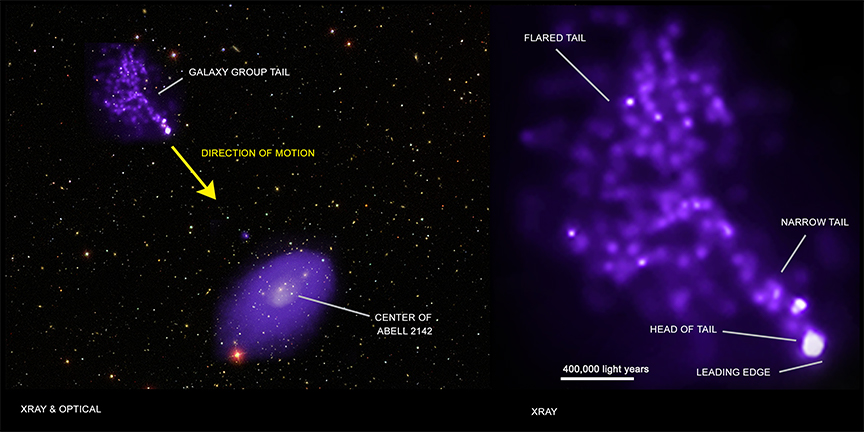
- It observed pressure fronts for the first time in Abell 2142, where clusters of galaxies are merging.
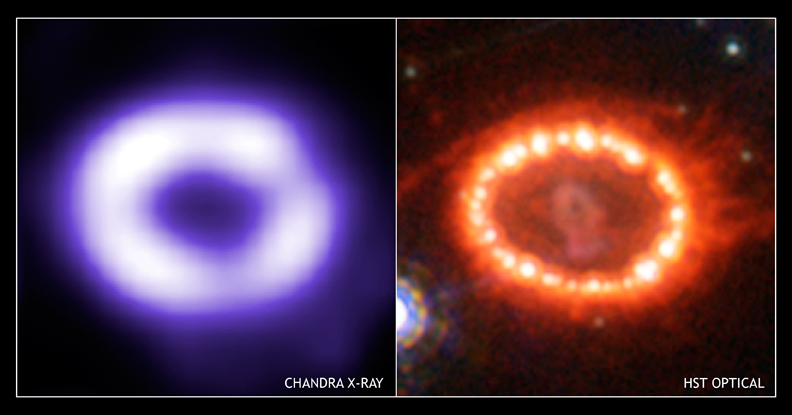
- The earliest X-Ray images of the shock wave of a supernova were taken of SN 1987A.
- X-Ray emissions from materials fralling from a protoplanetary disc into a star.
- In 2006, data from Chandra was used as strong evidence to show that dark matter exists, by observing super clusters colliding.
- Observations taken of the Bullet Cluster, helped put limits on the cross-section of the self-interaction of dark matter.
- It observed that Jupiter’s X-Rays come from the poles, not the auroral ring.
- A large halo of hot gas was found surrounding the Milky Way
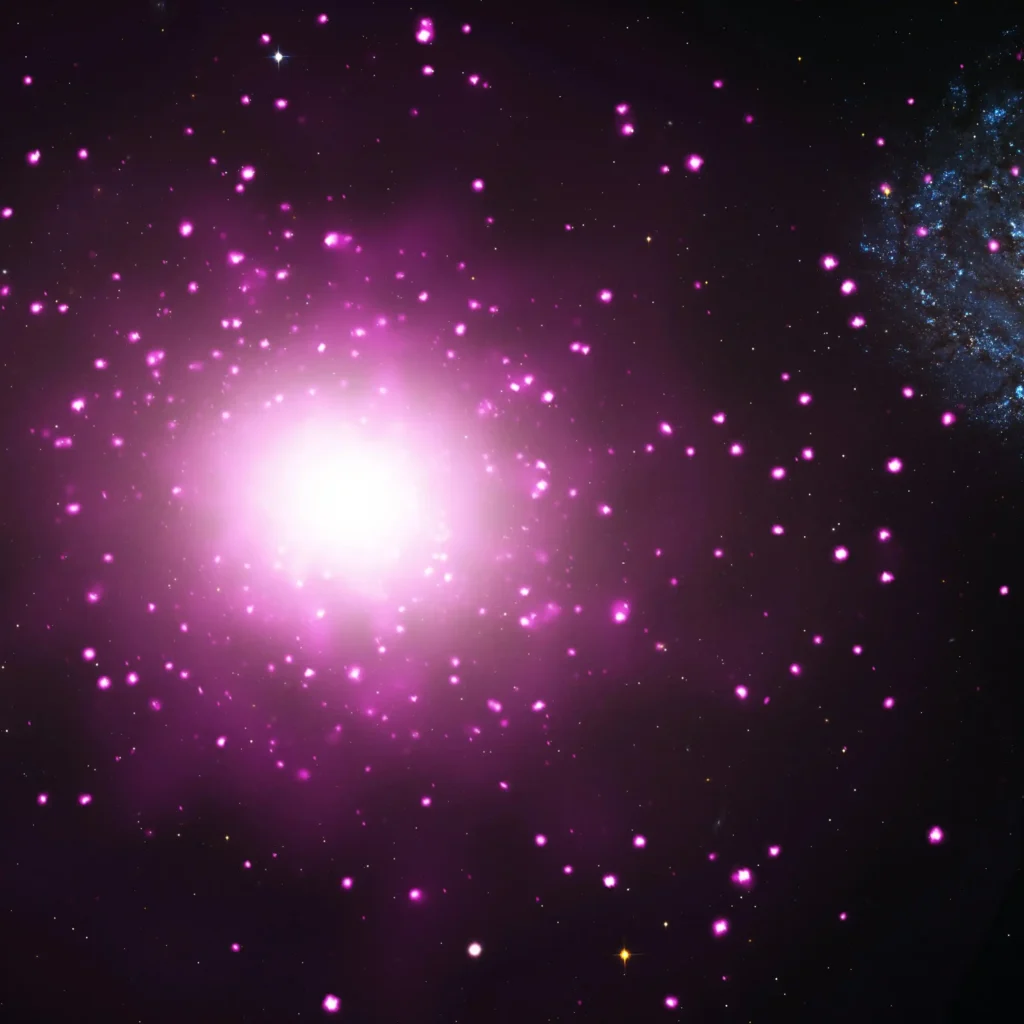
- A rare observation of a ultra-compact dwarf galaxy, M60-UCD1, was observed.
- In September 2016, it was announced that Chandra had detected X-Ray emissions from Pluto, which is the first of it’s kind for a Kuiper belt object. It made the observations in 2014 and 2015, to help support New Horizons which arrived in July 2015.
- In April 2021, NASA announced findings that Uranus gives off X-Rays, but it is not yet confirmed that the X-Rays originate from the planet, and not emitted by the sun.
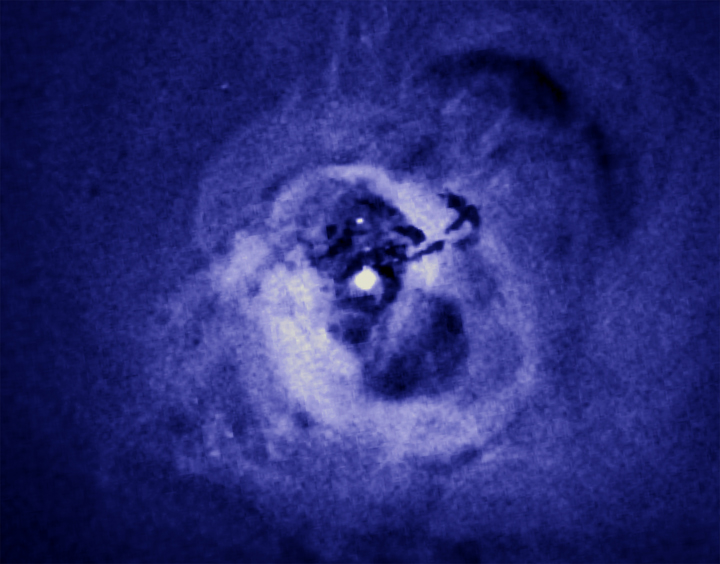
- It showed for the first time, the shadow of a small galaxy as it is being cannibalized by a larger one, in an image of Perseus A.
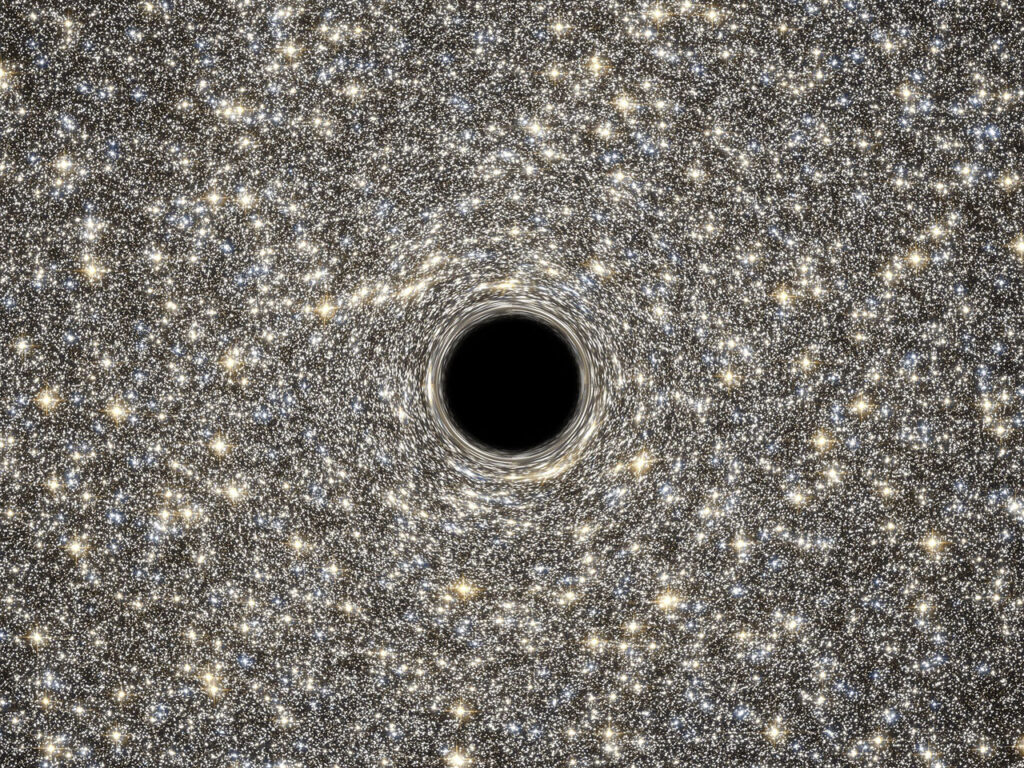
- It discovered a new type of black hole in the galaxy M82, which were mid-mass object purported to be the missing link between star-sized black holes and super massive ones.
- X-Ray emission lines were associated with a gamma-ray burst, Beethoven Burst GRB 991216.
- 3 high school students, all of the North Carolina School for Science and Mathematics (NCSSM) in Durham, NC, used data from Chandra to discover a neutron star in supernova remnant IC 443.
- Chandra data suggested that RX J1856.5-3754 and 3C58, previously thought to be pulsars, might be even denser objects, known as quark stars. This is still in debate.
- Sound waves from violent activity around a super massive black hole were observed in the Perseus Cluster.
- TWA 5B, a brown dwarf, was observed orbiting a binary system of Sun-like stars.
- The X-Ray shadow of Titan was seen when it transited the Crab Nebula
- With the help of Chandra, the Hubble Constant was measured to be 76.9km/s/Mpc {Mega Parsec}, using the Sunyaev-Zel’dovich effect.
- Also in 2006, X-Ray emitting loops, rings and filaments were found around a super massive black hole, withing M87, implying the presence of pressure waves, shock waves, and sound waves, which may have dramatically affected the evolution of M87.
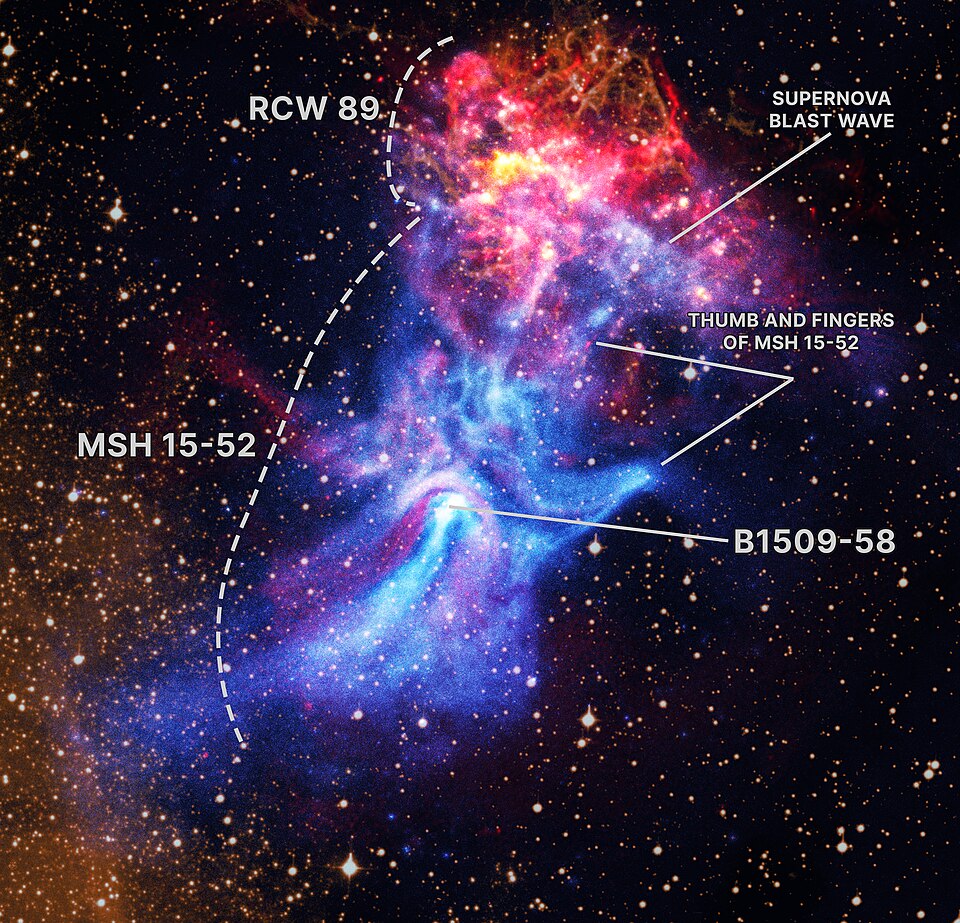
- It produced a widely known “Hand Of God” photograph of Pulsar B159-58
- On January 5th, 2015, (My birthday! I was 14.) NASA reported that Chandra observed an X-Ray flare 400 times brighter than usual, from Sagittarius A*. It is likely to be caused by a asteroid falling into the black hole, or a entanglement of the magnetic field lines.
- In September 2020, Chandra made an observation that is debated, of an exoplanet in the Whirlpool Galaxy, which would be the first planet discovered beyond the Milky Way.
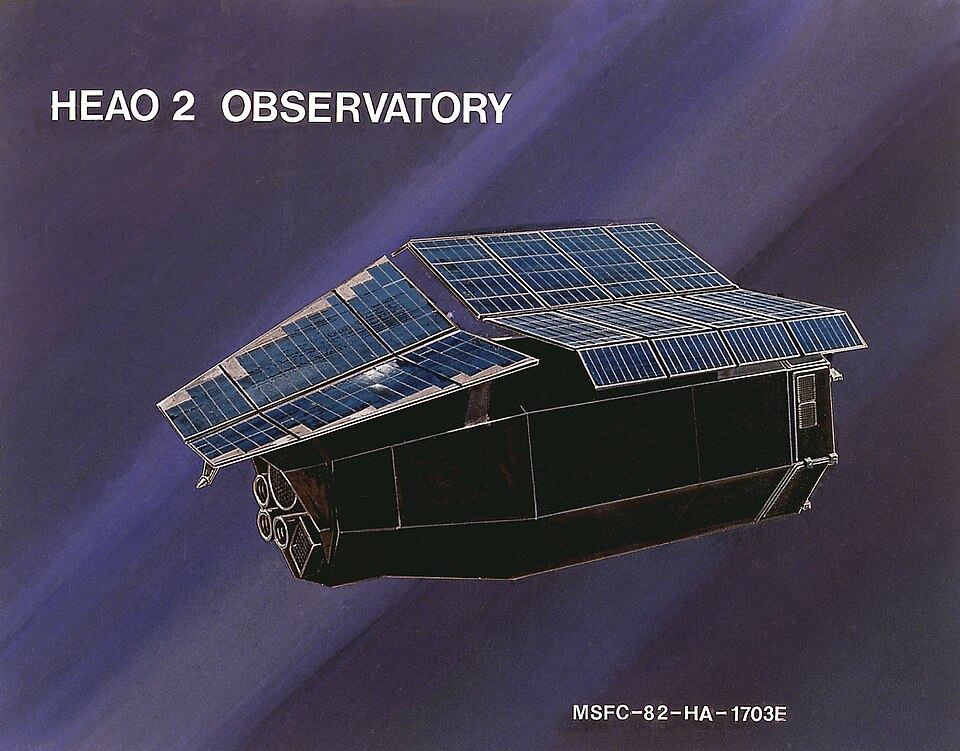
As mentioned previously, the Einstein or HEAO 2 observatory, was the first X-Ray telescope to be launched. It was a pioneer, and paved the way for the Chandra X-Ray Observatory’s later development.
Credit: NASA.
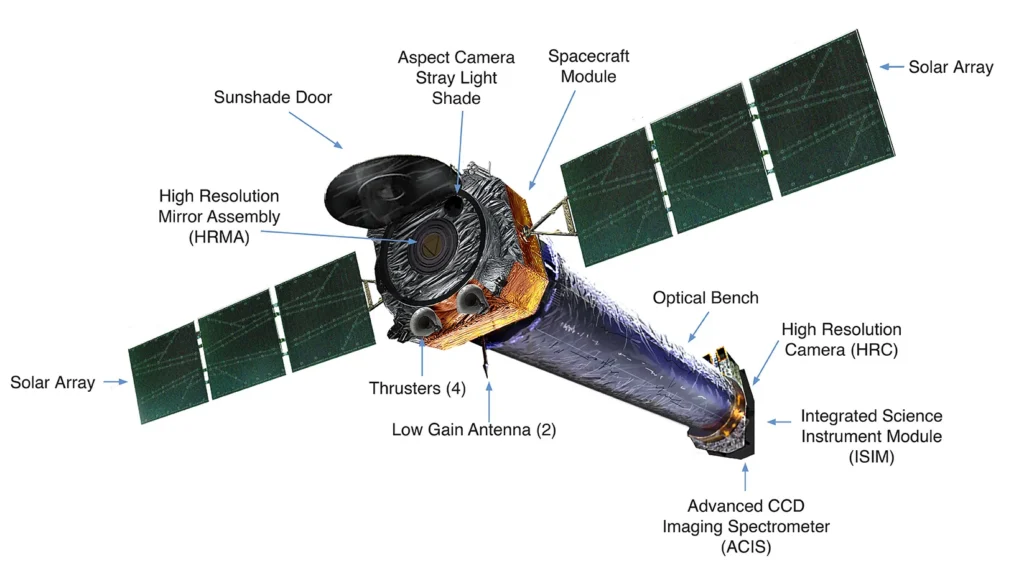
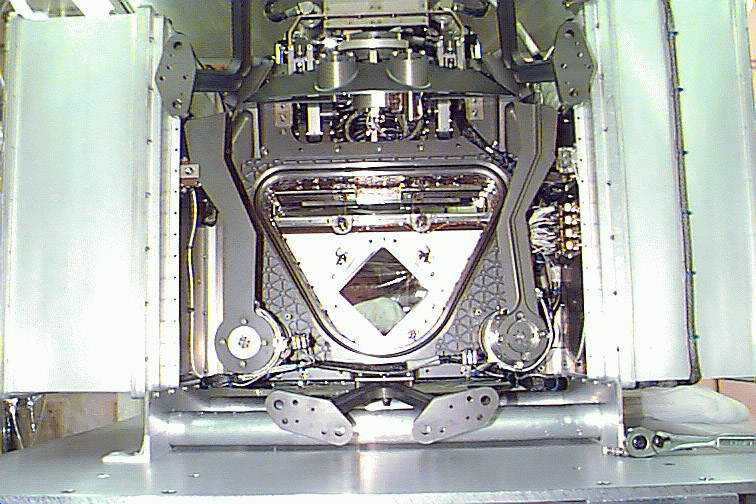
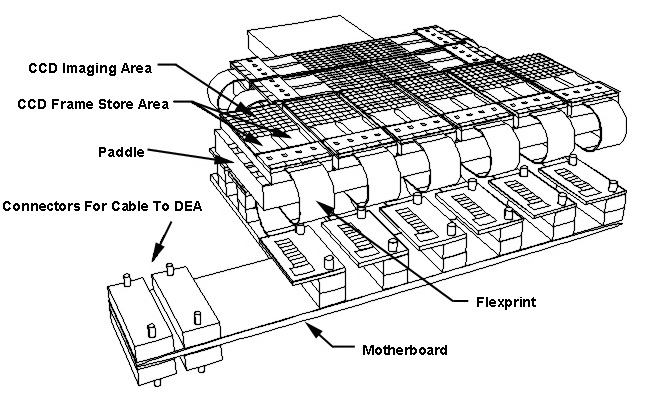
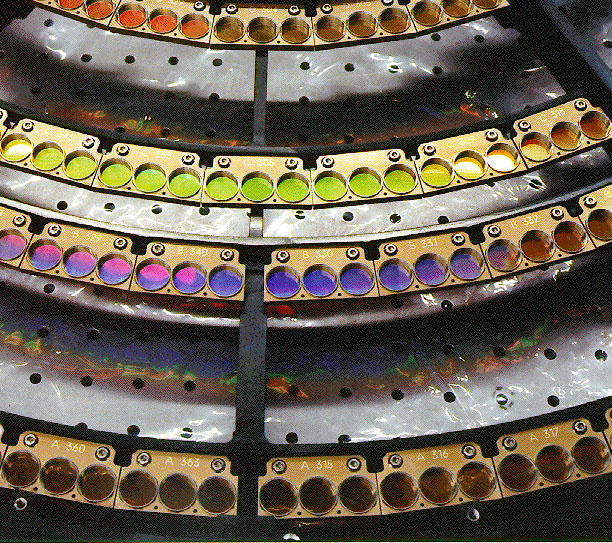
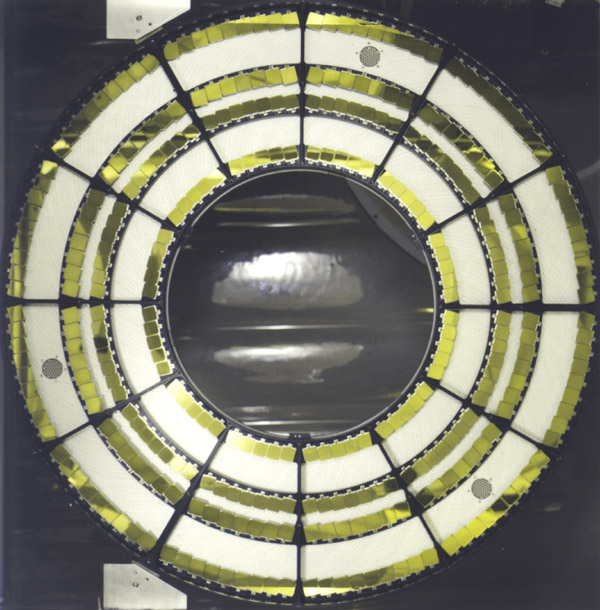
Chandra combines it’s main mirrors with four specific science instruments to capture and probe the X-Rays from astronomical sources.
Leave a Reply