

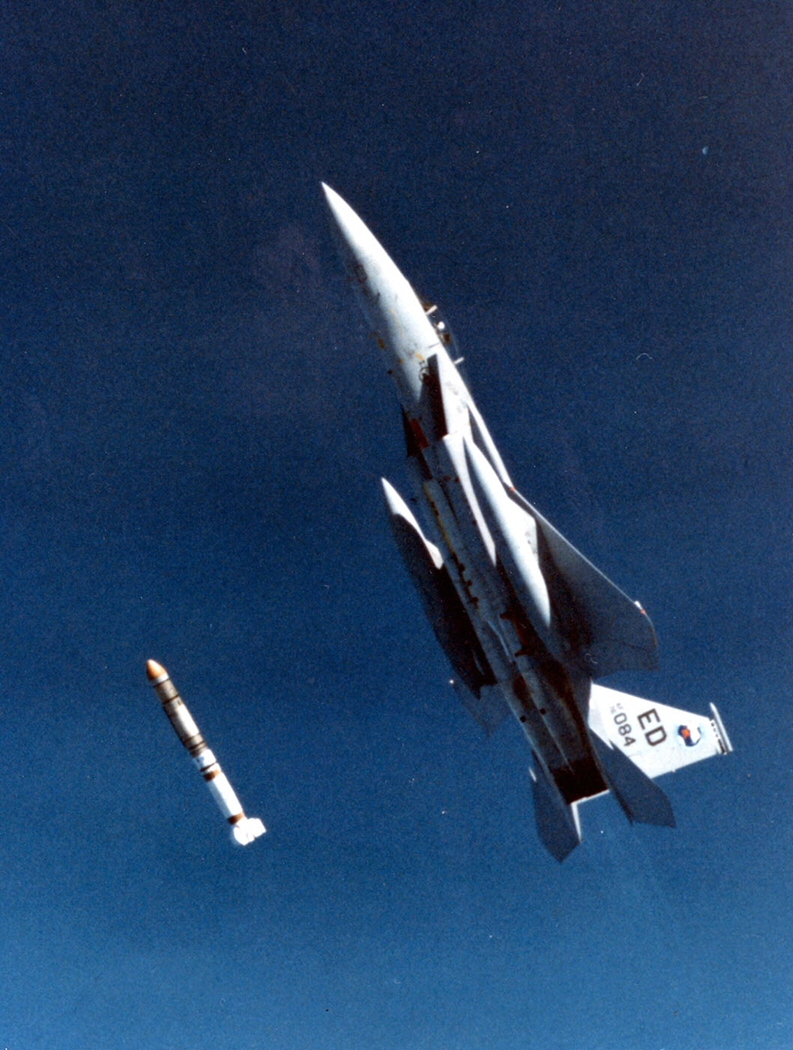
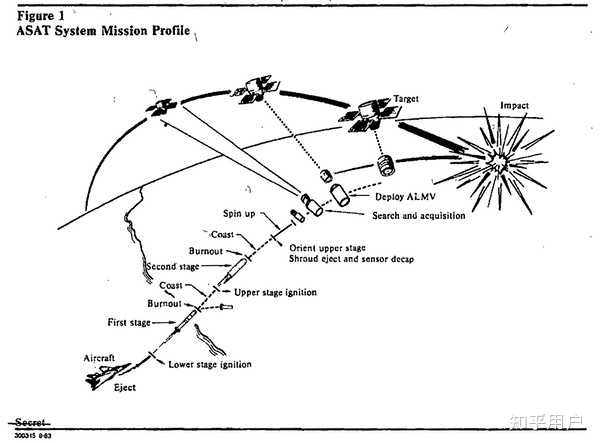
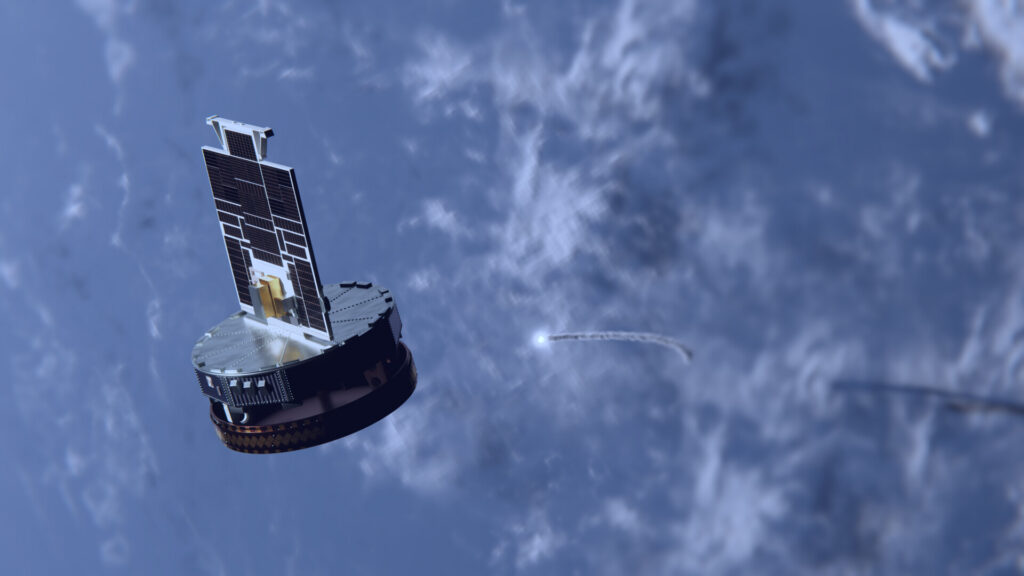
On the 13th September, 1985, an F-15A launched an ASM-135 Air-Launched Anti-Satellite Multistage Missile, at an altitude of 11.6km, knocking out and destroying the Solwind P78-1 satellite, flying at an altitude of 555km.
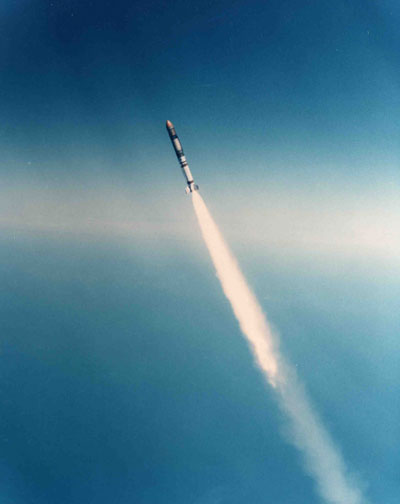
ASM-135 ASAT
The ASM-135 ASAT was a missile born out of a project that was originally conceptualized back in the 1950’s, where the USA began development of anti-satellite weapons. The first one was the Bold Orion weapon system, which was tested in 1959, but failed.
Over 20 years later, the ASM-135 was finally built, based on a modified Boeing AGM-69 SRAM missile, with three stages involved.
The ASM – 135 was designed to be launched from an F-15A in a supersonic zoom climb.
It consisted of three stages.
- Stage 1, had the modified AGM-69, with a solid propellent two pulse rocket motor.
- Stage 2, used a Altair 3 solid rocket motor. It also included hydrazine fueled RCS thrusters that could be used to point the missile towards the target satellite.
- Stage 3, consisted of a SRAM booster, and was called the Miniature Homing Vehicle Interceptor. Prior to the second stage being deployed, it would spin up to 30 RPM, and point it at the target.
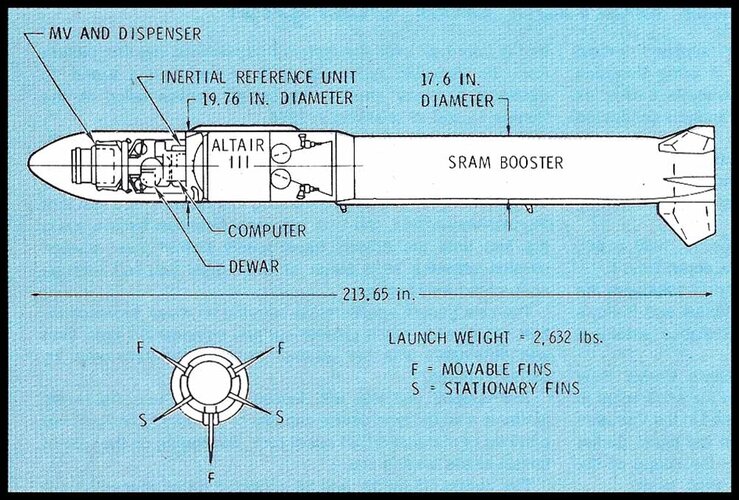
F-15A
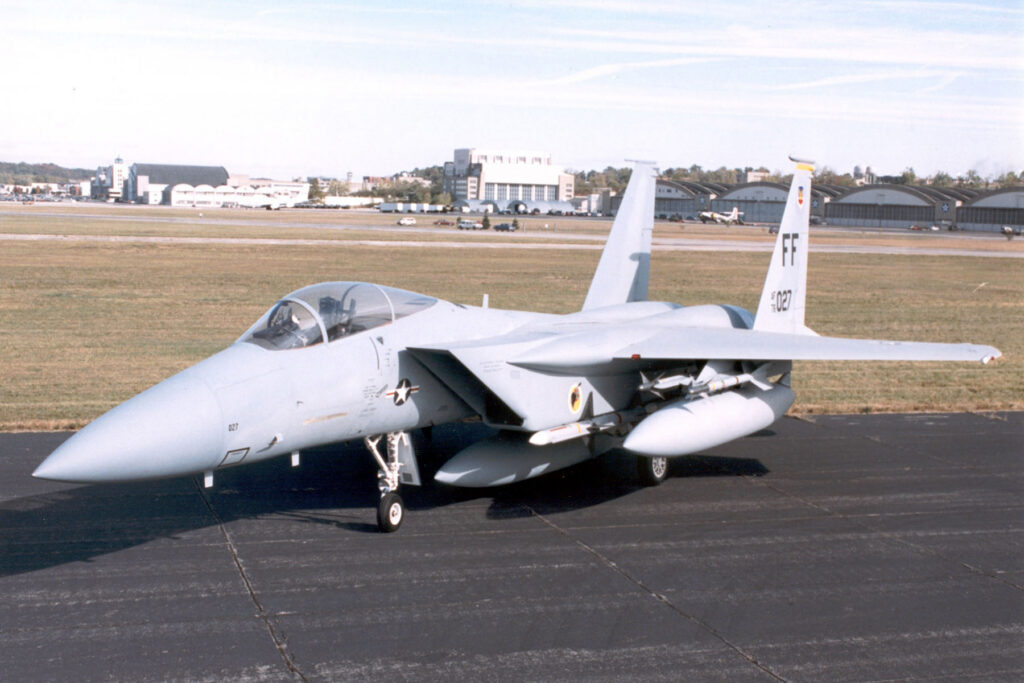
The F-15A
The F-15A was the first operational variant of the McDonnell Douglas F-15 Eagle. The F-15 was designed as the principal air superiority fighter of the US Air Force and several U.S. allies during the late cold war, replacing the F-4 Phantom II. 384 were built during the period of 1972-1979. With a combined engine thrust of 211.4kN, it was easily Mach 2 capable at altitude, with a range of 2,144 nautical miles. It would carry either 4x AIM-7 Sparrows & 4 AIM-9 Sidewinders or 6 AIM-120 AMRAAM & 2x AIM-9 Sidewinders.
Mission Profile
Following the authorization from Ronald Reagan to test against a satellite, a target, Solwind P78-1, which was a solar observatory, was chosen. On the 13th September, 1985, Wilbert Pearson, flying F-15A 76-0084, launched the ASM-135 about 320km west of Vandenberg AFB. Prior to the launch, the F-15, flying at speeds of Mach 1.22, executed a 3.8g0 (37m/s2) zoom climb at an angle of 65o. The ASAT was automatically launched at 11,600km, FL381, while the F-15 was flying at Mach 0.934. The final stage, the 14kg MHV, collided with the 910kg P78-1 satellite at a closing velocity of 24,000km/hr.
The Aftermath
Following the impact, NASA, working with the DoD, used two orbital debris telescopes, and a re-entry radar deployed in Alaska, to monitor the outcome. While they assumed the metal would be bright, the debris ended up being so dark, it was almost undetectable, and only 2 pieces were actively seen.
This was theorized to have been caused due to the carbonization of organic compounds inside the satellite, that when the kinetic energy of the ASAT became heat energy on impact, the plastics inside Solwind vaporised and condensed on the metal pieces as soot.
NASA used USAF infrared telescopes to show that the pieces were warm with heat absorbed from the sun. The pieces decayed quickly from orbit, implying a large area-to-mass ratio.
According to NASA, the last piece of debris had deorbited on the 9th May, 2004, named COSPAR 1979-017GX. There was 285 trackable pieces of debris, and by January 1998, only 8 had remained trackable, after 13 years.
The Solwind test had three important results.
- It raised the possibility that optical identification systems were actually detecting large, but dark items, instead of small but bright items which was the original assumption. This lead to major implications for the calibration of optical and radar orbital debris detection systems.
- It created a baseline event for researchers who wanted an idea of what a hypervelocity collision would be like in space.
- Awareness was raised about the orbital debris problem.
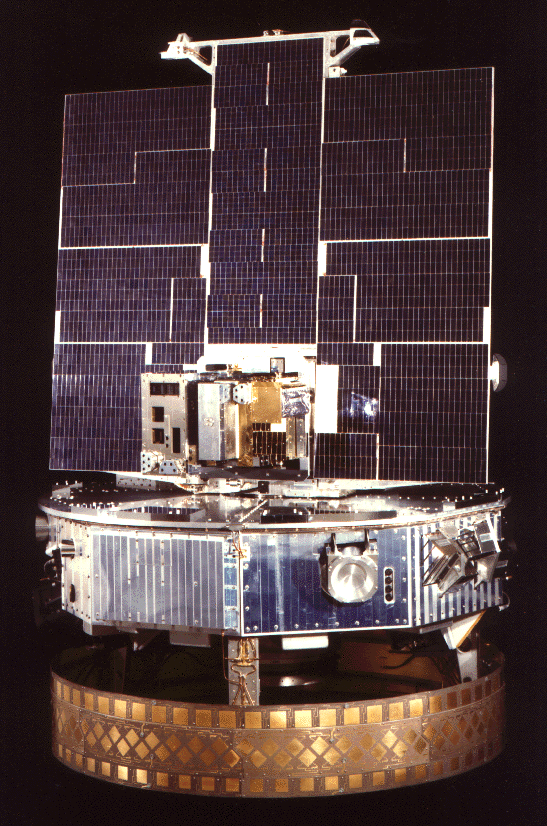
Solwind
Solwind was a US satellite launched aboard an Atlas F rocket from Vandeberg AFB on February 24th 1979. It’s original platform included a solar-oriented sail and a rotating wheel section. It carried a number of instrumentation.
- Gamma-Ray Spectrometer
- White-Light Coronagraph
- Extreme Ultraviolet Imager
- X-Ray Spectrometer
- High-Latitude Particle Spectrometer
- Aerosol Monitor
- X-Ray Monitor
P78-1 was the first satellite in space to discover a comet in general, and in particular, it discovered 9 sungrazing comets.
Comet Discoveries
| Designation | Solwind# | Image date | Discovery date |
|---|---|---|---|
| C/1979 Q1 (Solwind) | 1 | Aug 30th 1979 | Sep 1981 |
| C/1981 B1 (Solwind) | 2 | Jan 27th 1981 | |
| C/1981 O1 (Solwind) | 3 | July 20th 1981 | |
| C/1981 V1 (Solwind) | 4 | Nov 4th 1981 | |
| C/1981 W1 (Solwind) | 7 | Nov 20th 1981 | June 30th 2005 |
| C/1983 N2 (Solwind) | 8 | July 7th 1983 | July 19th 2005 |
| C/1984 O2 (Solwind) | 6 | Sep 25th 1983 | |
| C/1984 O2 (Solwind) | 5 | July 28th 1984 | |
| C/1984 Q1 (Solwind) | 9 | Aug 23rd 1984 | July 22nd 2005 |
| C/1984 R1 (Solwind) | 10 | Sep 17th 1984 | July 23rd 2005 |
Why Solwind?
Solwind was chosen, as by 1985, the satellite’s batteries were heavily degrading, leading to a frequent condition of “under-voltage cutoffs”, which is where it detected a low voltage, and automatically would shut down all non-vital systems. Also, the last of the three tape recorders failed in the spring of 1985, forcing data collection to only occur while the spacecraft was in contact with a ground station, which usually would only have a period of 15 minutes per orbit, (with a rough orbital period of 95 minutes), meaning per day it would only be in contact for 3.75 hours. Compared to the amount of data it was trying to send, and data rates at the time, this was nowhere near sufficient.
Because of all of these failures, the additional burdan on the Air Force Satellite Control Network would become too much, and discussions were already being had about termination of the mission. This led it to being chosen as a test target the for the ASAT launch, and the mission was extended for several weeks solely to support the test. During this time, it was allowed to remain in it’s under-volted state for multiple days at a time.
Following the test, a number of scientists were outraged. Because, although, five of the instruments had already failed, two were still in operation, and one solar physicist called it “the backbone of coronal research throughout the last seven years.”
->
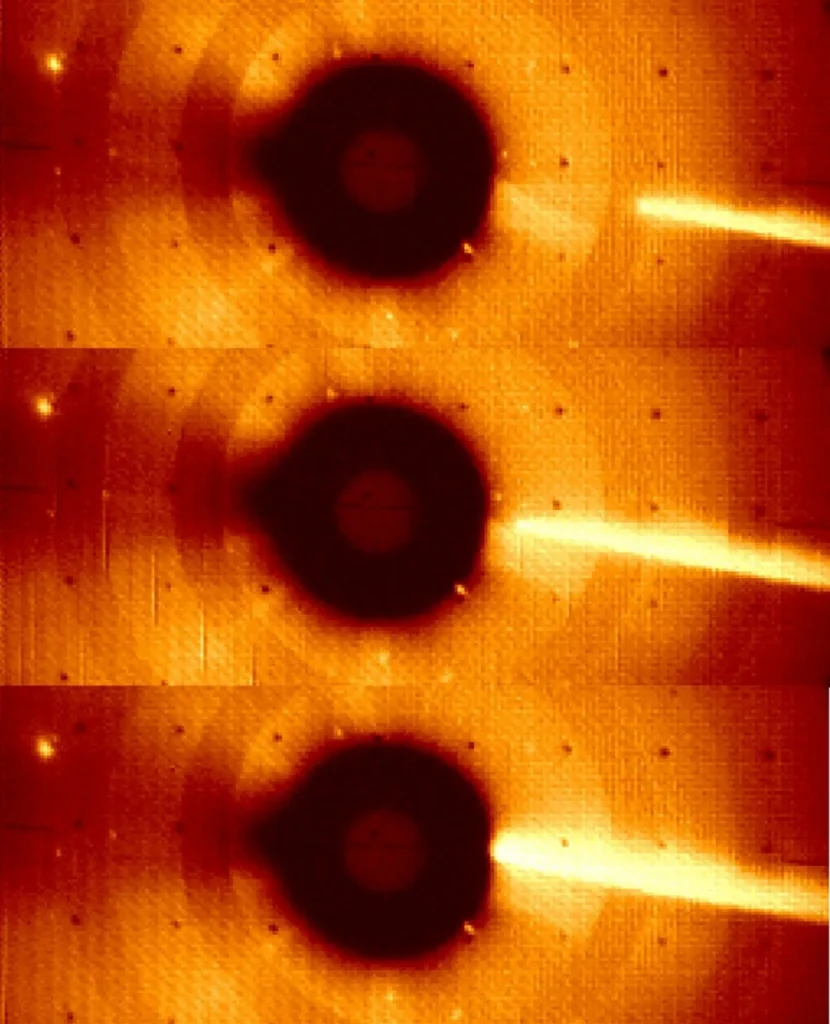
Seen Right: Images of Comet C/1979 Q1, during it’s original imaging date in 1979. Following this observation, the comet disappeared as it went past the Sun, suggesting it was destroyed. Later on, it would be mentioned as being part of the Kreutz-group of sungazing comets. It is actually possible that it plunged directly into the Sun, as opposed to grazing past it, but the quality of the data is not conclusive enough to determine this with any reasonable confidence. Credit: Naval Research Laboratory.
Leave a Reply