

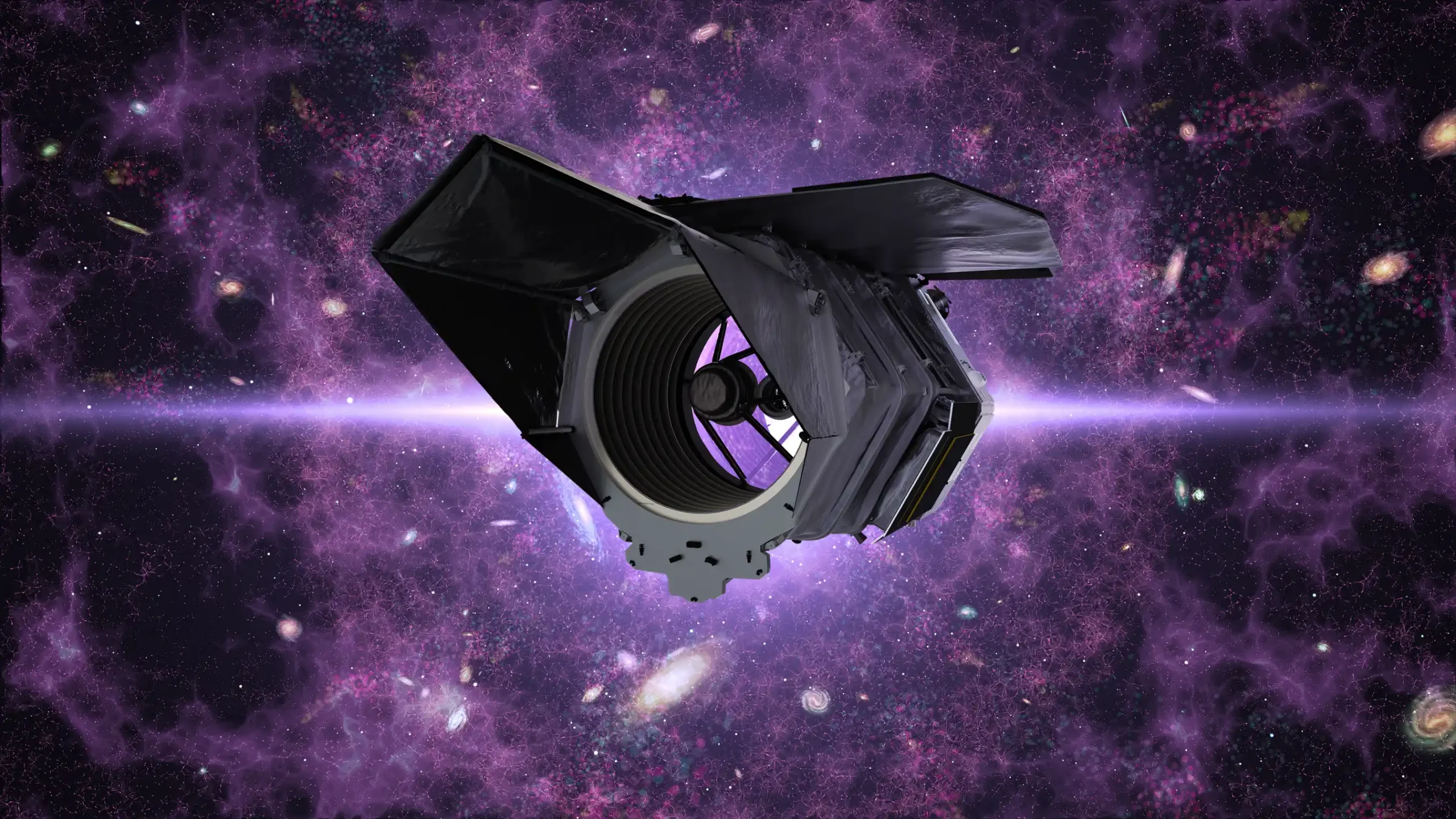
Nancy Grace Roman Telescope – FridayFunFact
June 19th 2026
The Nancy Grace Roman Telescope is NASA’s next premier space telescope, named after NASA’s first chief astronomer, Nancy Grace Roman, who is considered to be the ‘mother of the Hubble Space Telescope’. It will have a field of view of the universe which is, at least, 100 times larger than the Hubble Space Telescope, which will allow it to measure light from a billion or more galaxies in it’s expected lifetime.
It has the ability to block starlight from distance stars, allowing it to more easily see exoplanets, and planet-forming disks, which will allow it to complete a census of planetary systems in our galaxy, and help scientists to settle questions in the areas of dark energy, exoplanets, and infrared astrophysics.
NASA are also currently accepting name submissions until July 12th – where they will put all of the names onto a permanently attached SD card – meaning your name can be on the telescope forever. See here: https://my.nasa.gov/specialevents/s/send-your-name-with-nancy-roman
Right: A conceptual image of the Nancy Grace Roman Telescope
Credit: NASA / Goddard Space Flight Center
Nancy Grace Roman Telescope
| Names | Roman Roman Space Telescope (RST) Wide-Field Infrared Survey Telescope (WFIRST) Joint Dark Energy Mission (JDEM) |
| Mission Type | Infrared Space Telescope |
| Operator | NASA / GSFC |
| Website | https://roman.gsfc.nasa.gov |
| Mission Duration | 5 Years (Planned) |
| Manufacturer | NASA Goddard Space Flight Center |
| Launch Mass | 10,500kg (23,100lb) |
| Power | 4.5 kW |
| Launch Date | 30th August 2026 |
| Rocket | Falcon Heavy |
| Launch Site | Kennedy LC-39A |
| Contractor | SpaceX |
| Reference System | Sun-Earth L2 Orbit |
| Regime | Halo Orbit |
| Perigee altitude | 188,420km (117,080 mi) |
| Apogee altitude | 806,756km (501,295 mi) |
| Mirror Type | Three-mirror anastigmat |
| Mirror diameter | 2.4m (7.9 ft) |
| Focal Ratio | f/7.9 |
| Wavelengths | 0.48-2.30 μm (blue to near-infrared) |
| Transponder Bands | S-band (TT&C support) Ka-band (data acquisition) |
| Bandwidth | Few kbit/s duplex (S-Band) 290 Mbit/s (Ka-band) |
| Instruments | WFI – Wide-Field Instrument CGI – Coronagraph Instrument |
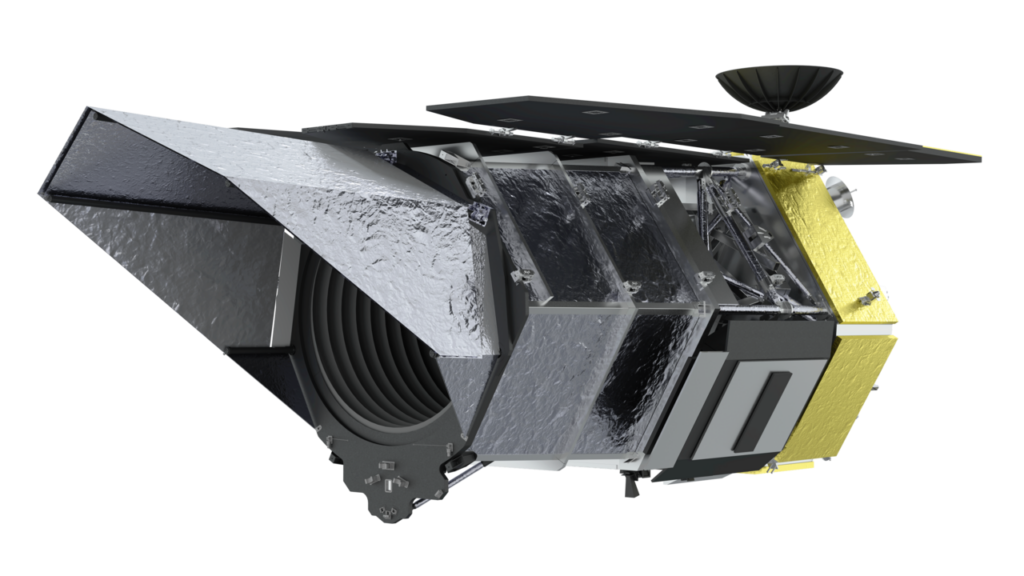
Credit: NASA / Goddard Space Flight Center
Leave a Reply